
Remembering Exeter Together: Our Reminiscence Sessions at Watermeadow Grange
By Kitty Vega, Isca Photographic Collection Project Officer
As a project team, one of our central aims throughout the Isca Photographic Collection Project has been to connect people meaningfully with Exeter’s past. While much of our work focuses on conserving and digitising a fragile archive, the heart of the project lies in the lived experiences and memories that bring these photographs to life. Our reminiscence sessions at Watermeadow Grange Care Home in October 2025 became one of the most rewarding ways we achieved this connection.
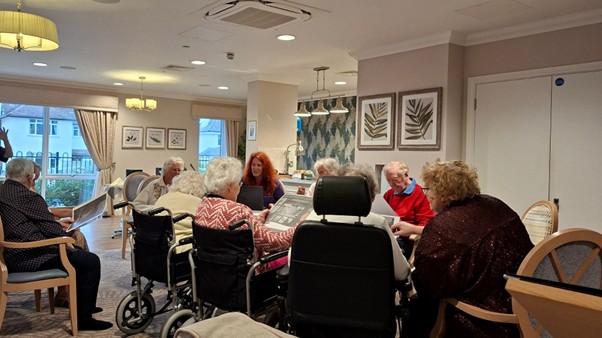
Creating a Safe and Supportive Space for Memory
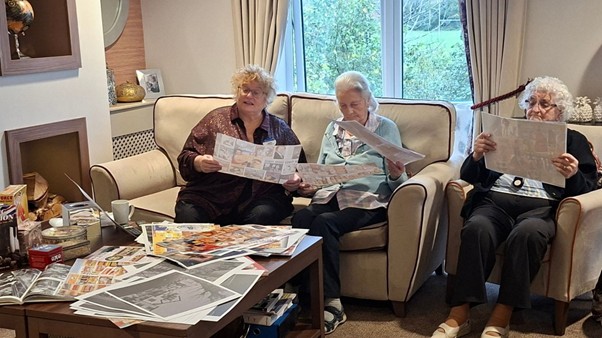
Together with Reminiscence Learning, we delivered three 90‑minute sessions shaped around enlarged historic photographs of Exeter from the Blitz era and the city’s post‑war regeneration. Because many participants live with dementia or cognitive impairments, each session was carefully designed to be supportive, flexible, and sensitive. We built the sessions around “safe themes” such as school days, family life and hobbies, and high street memories, which provided familiar entry points for discussion while still allowing space for deeper wartime memories to surface when participants felt comfortable.
The photographs were paired with sensory prompts, such as household objects, fabrics, tins, and era‑appropriate music. These elements created a multi‑sensory environment that helped participants reconnect with moments, places and feelings that had sometimes lain dormant for decades.
Listening to Lives Lived Across Exeter
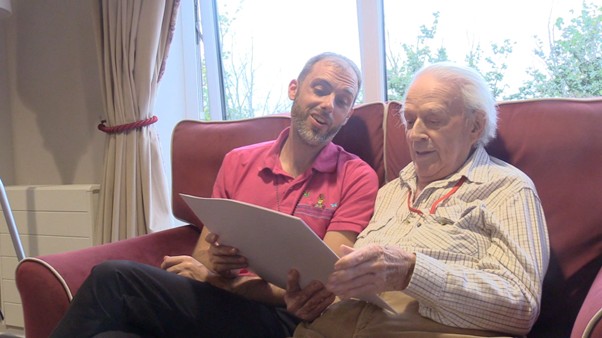
The participants, all over 80 and many long-term residents of Topsham or Exeter, brought remarkable energy and openness to each session. Conversations flowed naturally: small groups formed around particular images, memories sparked memories, and the room filled with shared stories. Some participants brought their own photos or diaries, while others reflected on childhood experiences of wartime Exeter or the changes they witnessed as the city was rebuilt.
A few comments that stayed with us included:
“It is so lovely to sit and chat with people, even if it can be difficult remembering things from back then.”
“I feel like a film star.”
“It was hard talking about my husband, but it was good to share his photograph and his experiences.”
“I like the big images, they brought back memories of things I’d forgotten I’d seen.”
Care staff later told us that participants continued talking for up to an hour afterwards, still animated and sharing memories the photographs had evoked.
Shaping the Project Film and Exhibition
The stories, interviews and filmed moments gathered during these sessions directly informed the 20‑minute project film that featured in the upstairs gallery of our Exeter Through the Lens exhibition at Exeter Custom House. Visitors repeatedly described the film as a highlight of their experience, and its emotional depth was shaped in no small part by the voices and memories shared at Watermeadow Grange.
Looking Ahead
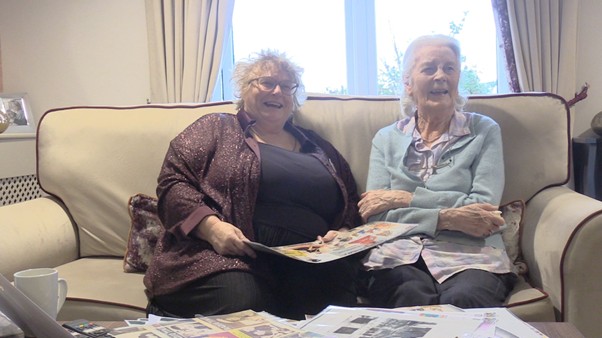
These reminiscence sessions have become a meaningful strand of the project’s legacy. They demonstrated that Exeter’s photographic history is not only something to be preserved and studied but something to be felt, remembered and shared.
Acknowledgments
Thanks to National Lottery players

The Isca Photographic Collection project is made possible with The National Lottery Heritage Fund. Thanks to National Lottery players, we have been able to preserve an irreplaceable record of twentieth-century Exeter.
The project builds on the foundational work of historian and photographer Peter Thomas who created the Isca collection. It is supported by the Friends of Devon’s Archives.