
The West Somerset artist Rachel Reckitt (1908-1995) experimented with different subject matter, styles and media across her life, including paintings, sculpture in wood and metal, and wood engravings. Her work is on display in the exhibition ‘Chance Encounters: The Art of Rachel Reckitt‘ at the Museum of Somerset, 19 October to March 2025.
Our team has chosen four stand-out pieces, that celebrate Reckitt’s unique artistic talent, and describe their personal appeal.
1 & 2 Portuguese Boy in Elvas and Blacksmiths Demonstrating
By Sarah Cox, Exhibition and Programme Manager
I really admire Reckitt’s choice of subject matter over everything else. Her paintings often represent those underrepresented by the artistic establishment. And you can see, throughout this exhibition, that Reckitt has a keen observational eye for people and their interactions within various landscapes, which gets translates into unique compositions that feel entirely her own.
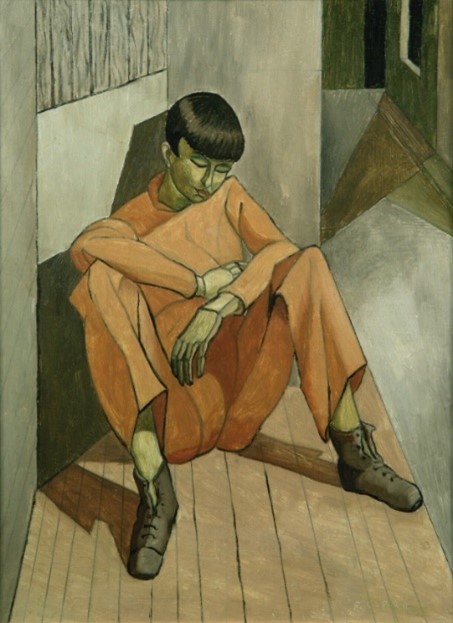
Portuguese Boy in Elvas, 1956. Oil on board, 61 x 45 cm.
Portuguese Boy is just one instance where Reckitt notices and depicts the quiet beauty in the everyday human figure. This painting is special as the photograph that inspired it has survived and was found in her travel journal. By comparing the final artwork with her initial photograph we get a rare insight into the choices whilst developing the final composition. The boy’s face has been cropped much closer than in the photograph and the lines of the flooring exaggerated to draw the eye towards the boy. As with the photograph, the shadowed alley has been represented using dark tones, but Reckitt has flattened the perspective and depicted it with geometric shapes. It seems to connect the boy to his surroundings.
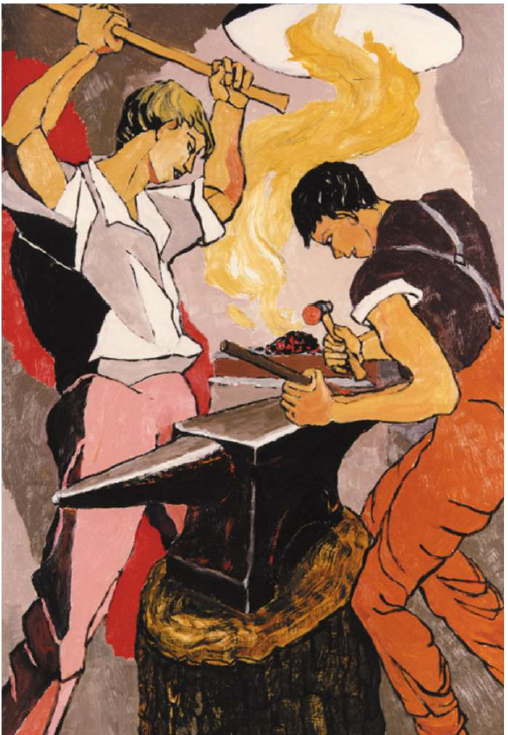
Blacksmiths Demonstrating, 1988. Oil on board, 72 x 40 cm.
Whilst not in the ‘Chance Encounters’ exhibition, I do want to mention this artwork. It’s another oil painting, again with a focus on figures at work, but the subject matter shows her love of metalworking and the forge. The energy that must have been experienced within a forge has been brought into this dynamic and vibrant painting. The powerful, thunderbolt-like striking of the hammer, the blazing heat, and intense physical exertion are all seen on the canvas. Reckitt’s figures were often ambiguously gendered, but given that the painting was produced soon after Reckitt’s inclusion in the All Women Exhibition at the Fire & Iron Gallery (1986), this painting seems to represent her focus on being a female blacksmith, and (one of the reasons why I like this piece) her experience of being one too.
3. Boat Shed at Dingle
By Bethan Murray, Curator of Social History, Costume and Textiles
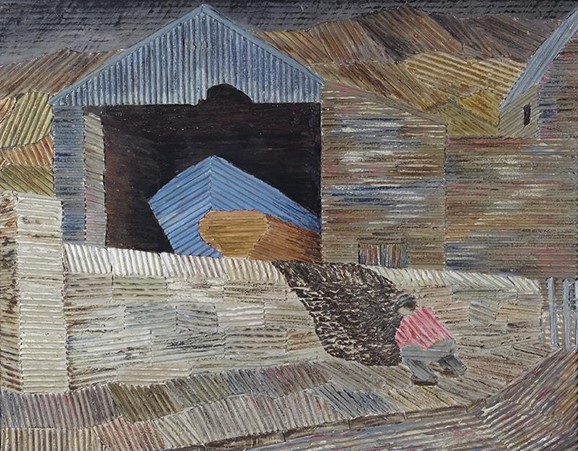
Boat Shed at Dingle, c. 1962. Oil on corrugated card
The corrugated card pieces speak to me the most, out of all Rachel Reckitt’s art displayed in the exhibition. ‘Boat Shed at Dingle’ uses corrugated card which is painted with oil paints and then collaged onto a canvas. I like the fact that I can see Reckitt’s artistic development within this composition, the strong lines echo her earlier wood engravings of the 30s. Reckitt’s wood engravings from her early career depict lots of curving lines, simplification of form, and solid blocks of black and white. ‘Boat Shed at Dingle’, 30 years later shows her artistic growth and desire to, perhaps, push her own boundaries in the experimental use of materials, but it still retains Reckitt’s trademark angular blocks of colour, solid lines and simplified forms that construct the boat shed building. Not to mention it’s such an eye-catching and striking composition with the vivid blue amidst the neutral grey and beige tones.
4. Mother and Child
By Becky Rogers, Marketing Assistant
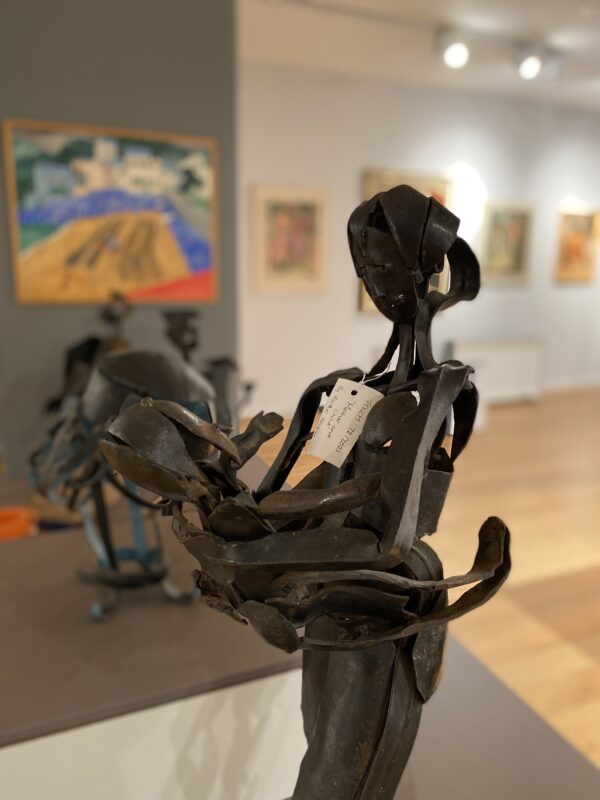
Mother and Child, late 1970s. Forged and welded steel, 80 x 44 x 23 cm
There were many amazing pieces, but my favourite is the metal sculpture ‘Mother and Child’, which I kept coming back to as I circulated the gallery. On reflection, I think this sculpture resonates with me on a personal level. The anonymity of the two forms carries a sense of history and timelessness. The firm embrace combined with the space between the two forms caught my attention. The positioning and shape, the posture chosen seems to encompass both the joys and challenges of motherhood. This juxtaposition is also felt through the dark metal and the lighter negative space seen through the gaps. I also really enjoyed ‘Cockerel, 1972’ (forged and welded steel, 30 x 25 x 17 cm), a small yet fun sculpture.