

A Survey of the Use of Traditional Building Stones in Somerset
By G.J. Dawson and P. Wright
In 2015 volunteers Garry Dawson and Peter Wright embarked on a remarkable research project to investigate the use and distribution of traditional building stones in Somerset. This has evolved into an ongoing and successful partnership between the South West Heritage Trust and the Somerset Geology Group.
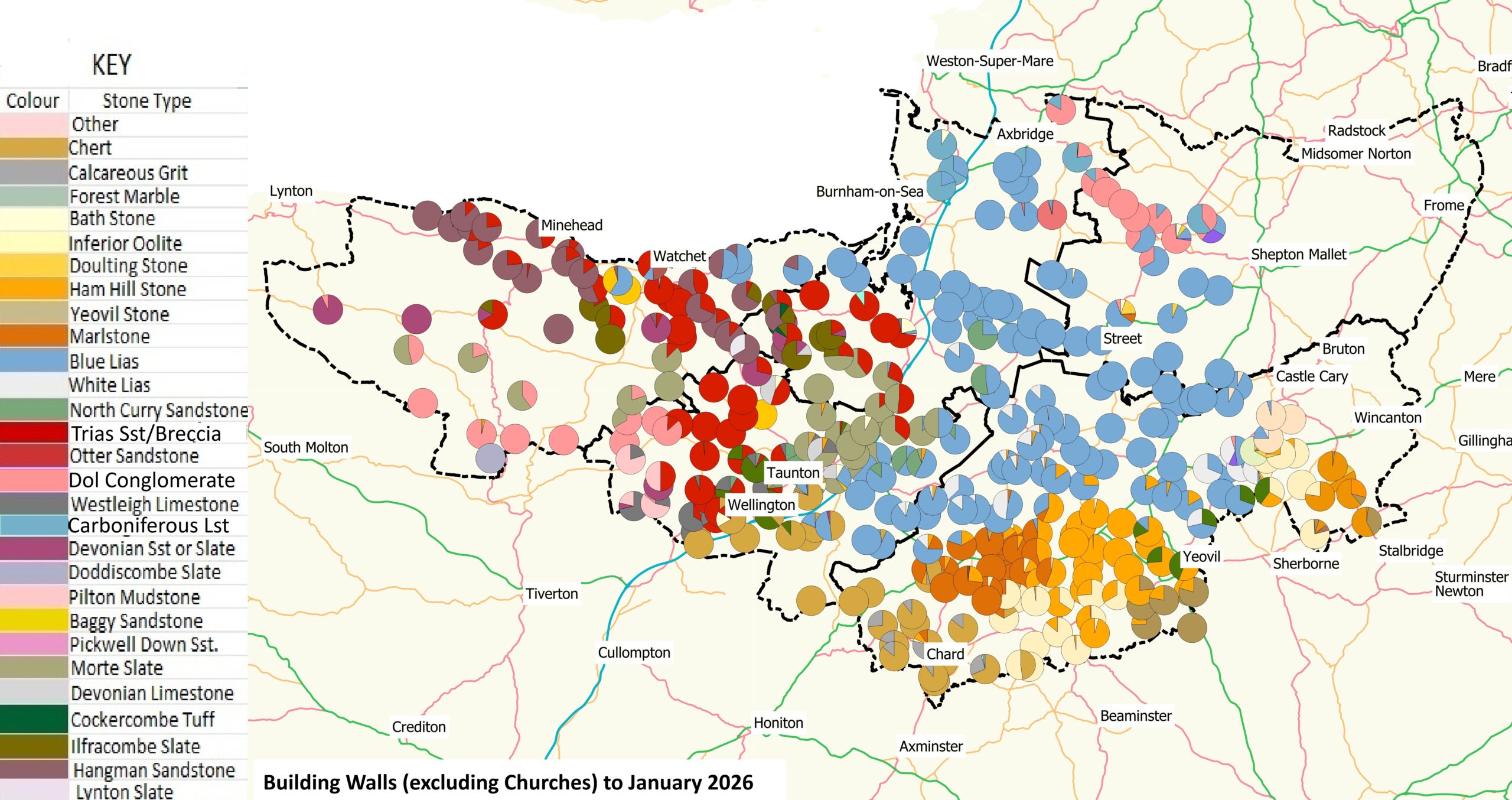
It’s now appreciated that the genius loci, or character, of our historic settlements is fundamentally shaped by local building material. It was back in 1965 that the architectural historian, Alec Cliffton-Taylor, first published his seminal book ‘The Pattern of English Buildings’ in which he wished to explore ‘the visual aspect of our buildings, and the reason why they look as they do in one place, and perhaps so different only a few miles away’.
The research is demonstrating the tight correlation between the rich variety of building stones in Somerset and the bed rock below. The research findings are frequently referenced and have informed numerous local building projects and studies in the historic environment.
Garry and Peter continued their survey until October 2022 when, very sadly, Peter passed away after a short illness. Garry knows that Peter wished for the work to continue, and with the help of local geologists Sheila Alderman, Doug Robinson, Andy Gordon and Val Graham, restarted the survey in 2023. Peter’s skills, dedication and good nature will be dearly missed.
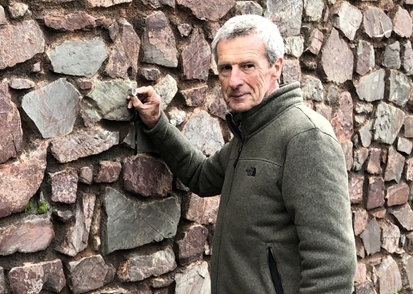
About the Volunteers
Garry graduated in Geology from the University of Leeds in 1975. After two years working offshore in North Sea oil exploration, he joined the United Kingdom Hydrographic Office in Taunton where his work covered navigational charts, satellite remote sensing and oceanographic data collection/databases. In retirement he has spent his time pursing geological interests and volunteering in the Quantock Hills.
Peter, having graduated with a degree in physical geography and a PhD in coastal geomorphology, worked for 35 years at the United Kingdom Hydrographic Office in a variety of technical and managerial roles. He retired in 2014 to pursue interests in geology, local history, cartography, photography and cycling, which he continued until shortly before he died.

Sheila studied geology through the Open University and for many years was the Open University Geological Society Branch Organiser for the Wessex region. She has a specific interest in the identification and use of stone in buildings and is a founder member of the Dorset Building Stones Group.
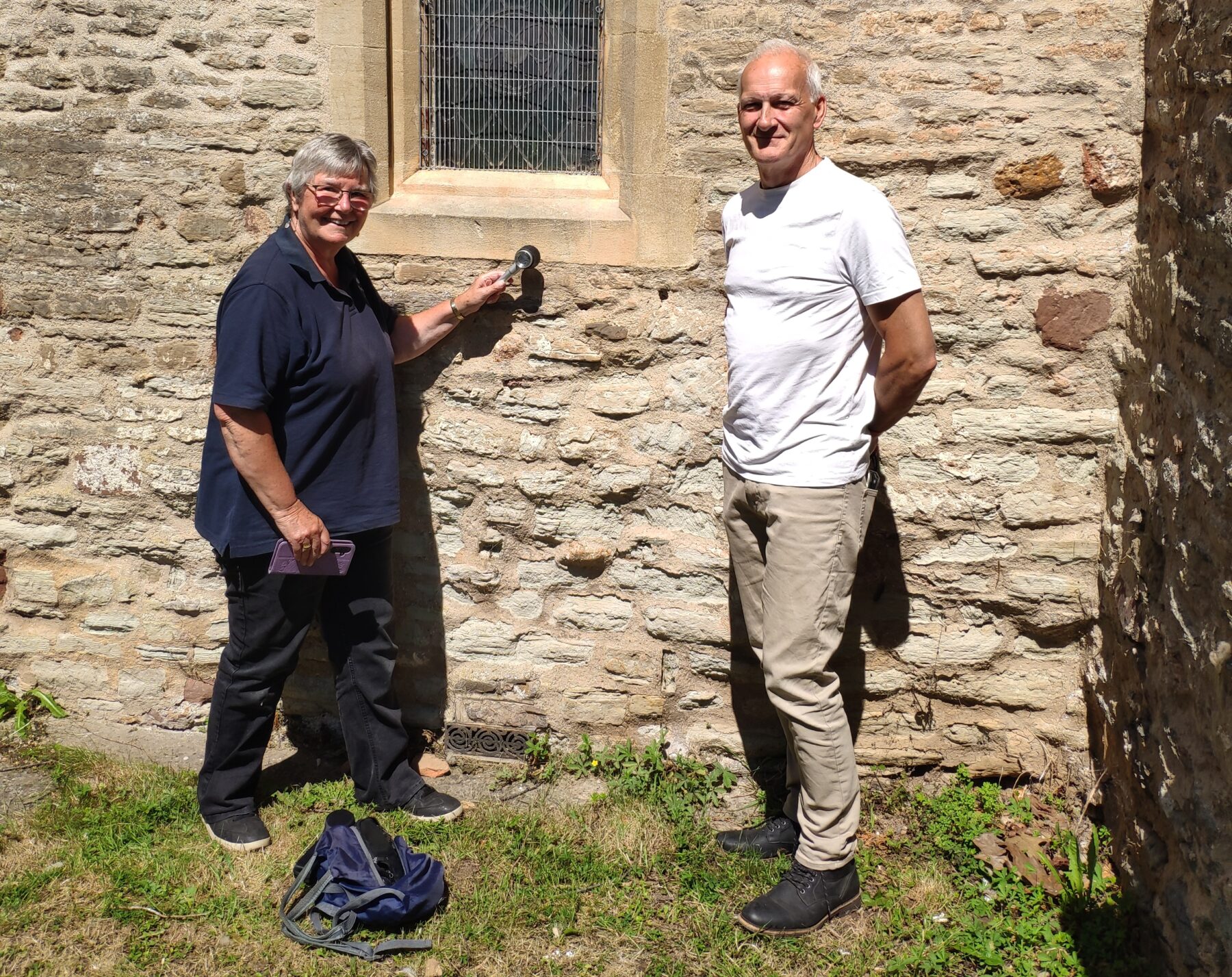
Doug is an honorary research fellow and retired lecturer from Bristol University, whose main interest has been in low-grade metamorphism and geochemistry. Since retirement he has led geology field trips for numerous different groups and has a particular interest in the geology and building stones around Wells where he lives.
Val graduated in Environmental Science from UEA in 1978 and worked in IT for 35 years. Since retirement he has returned to environmental issues as a volunteer, with particular interest in botany and geology.
Andy gained a geology degree at Edinburgh University in 1982. After 5 years working on oil drilling rigs, mostly in the Norwegian Arctic Circle, he made a career change to IT Networks and Communications. In 2021 he moved to Yeovil. On retiring in 2022, Andy joined the Somerset Geology Group and the Dorset Building Stones Group where he has rediscovered his love of geology.
About the Project
Between 2015 and 2022 the volunteers committed over 2400 hours surveying 226 historic settlements containing 8274 buildings, 218 churches and 2249 boundary walls (figures up to September 2022).
Their skills and commitment have produced a research resource that is in-depth, reliable, and tailored to the needs of building conservation and place making. Their findings provide:
- an overview of the relationship between geology, transport and local building materials;
- an assessment of the key building stones and materials for each settlement; and
- a detailed record of roof coverings, boundary walls, dressings, church walls, church dressing, and prominent buildings.
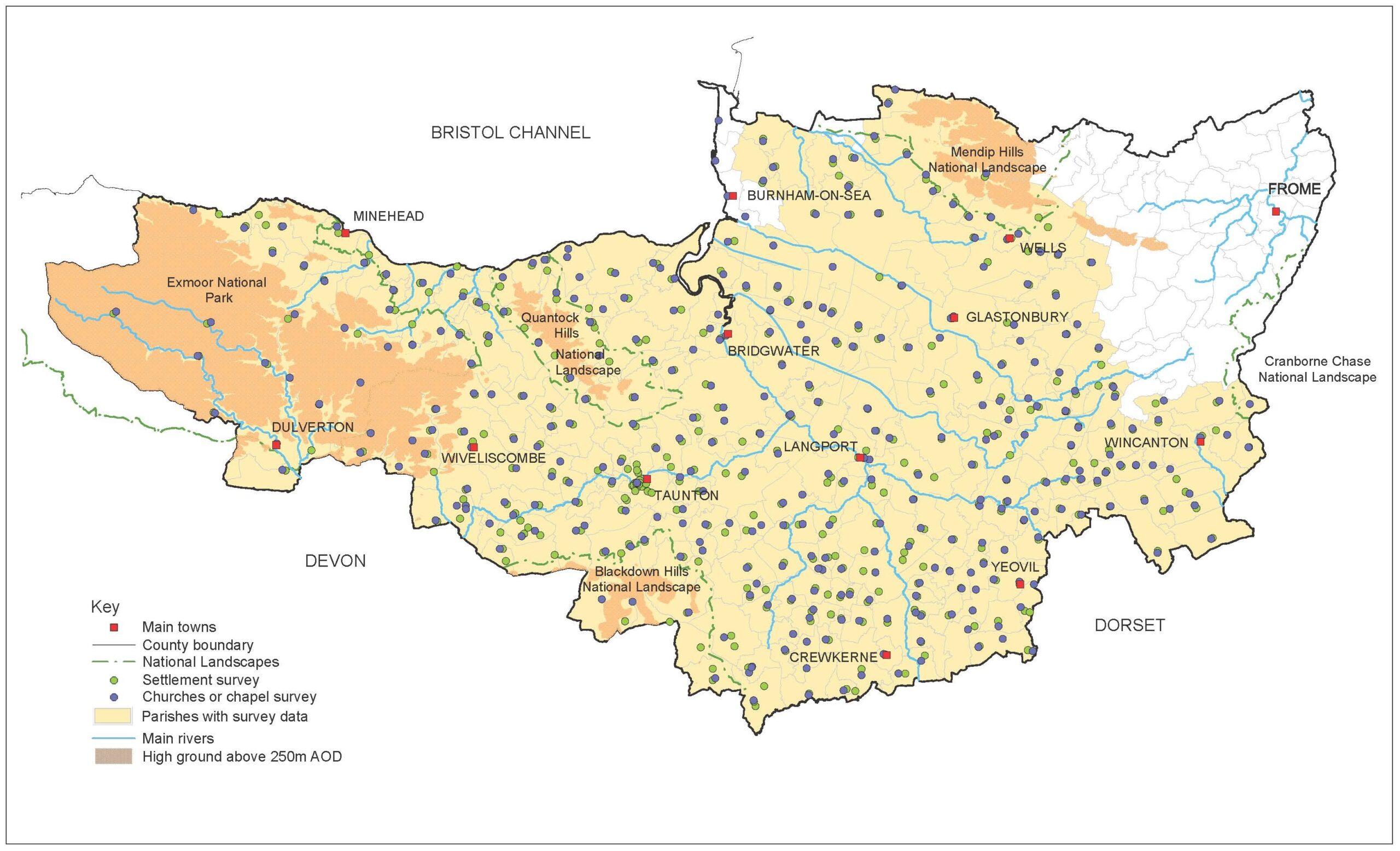
To date, the research has covered the Vale of Taunton Deane and the Blackdown Hills, the Quantock Hills and surrounding settlements, Exmoor, the Brendon Hills, Bridgwater, the Polden Hills and much of the Somerset Levels and Moors, and southern Somerset to the east of Yeovil. The work continues with further surveys on the Mendip Hills and in the east of the county.
Report Findings
The findings from the research in Taunton Deane, the Quantock Hills, and the western part of South Somerset (up to the River Parrett) from the first five years of the project are presented in a report to the South West Heritage Trust. The report contains the following elements:
- Explanatory paper on the methodology and findings.
- Appendix A. Table and map of the rock types used as building stones in Taunton Deane.
- Appendix B. Maps showing the use of stone and other building materials in Taunton Deane.
- Appendix C. Table listing by place-name the use of building stones in Taunton Deane.
- Appendix D. Table and map of the rock types used as building stones on and around the Quantock Hills.
- Appendix E. Maps showing the use of stone and other building materials on and around the Quantock Hills.
- Appendix F. Table listing by place-name the use of building stones on and around the Quantock Hills.
You can download the report here.
Further reports will be published as the survey continues with new or refined conclusions, if relevant, based on the new data. All the new data up to December 2025 is available below.
Detailed Survey Data
The survey findings for the settlements were collected in Excel data sheets. These provide a detailed percentage and numerical breakdown of the building stones, building materials and roof materials for each settlement.
The extent of the survey to May 2026 is illustrated on the map above. You can download the survey findings up to December 2025 here.
Somerset Town Building Stone Trails
To complement the data collected by the Somerset Traditional Buildings Stone Survey the Somerset Geology Group in late 2024 agreed to compile a series of Building Stone Trails. These enable visitors and locals alike to see the building stones detailed in the survey (many of which can no longer be safely examined in natural outcrops or quarries) as they walk around Somerset’s historic towns and villages. The first two guides, for Yeovil and Taunton, can be downloaded from the Somerset Geology Group website’s Geo-interpretation Page, or directly: Yeovil and Taunton.
Other Research
The following research publications and websites complement the Somerset Traditional Buildings Stone Survey:
- Barr M.W.C B (2019) Inventory of the Building Stones of Devon & adjacent parts of Dorset & Somerset; Volumes I & II. You can download: Volume 1, Volume 2, the map. They are also available as hard copies at the Devon and Somerset Local Studies Libraries. Please refer to the library categories on this website. Mike Barr’s full database of over 25,000 observations in Devon and Somerset is available at the Devon Heritage Centre. Please see the Devon Archive Catalogue Record for Archive Reference ZBJM.
- Prudden H. C. (unpublished) Table of Building Stones in Somerset Churches (Data collected to 2006 by H Prudden. Reformatting and minor additions by G Dawson 2019 to 2026).
- Dorset Building Stone Study identifies the stones used in the historic buildings of the county and adds to the sum of knowledge about historic buildings. Available at https://www.dorsetbuildingstone.org/.
- Somerset Geology Group and its website aims to provide a gateway to finding out about the geology of Somerset. Available at https://somersetgeology.org.uk.