


There have been two design experiments for a new reconstruction of an Iron Age roundhouse based on the recent excavation evidence from Glastonbury Lake Village. These have helped to show how far we can push the use of materials to replicate the relatively flimsy character of the original buildings (see below). The final build will begin this winter early in 2025 although we have retained the porch structure from the early experiments. We hope to finish the build for the summer.
The best evidence

The roundhouse is based on evidence from Glastonbury Lake Village, a site halfway between Glastonbury and Godney. The Lake Village was built on a patch of wet woodland surrounded by a huge area of reed beds and open water and was occupied from 150-50 BC. The waterlogged peat allowed organic materials, such as wood, to survive and made the site one of the best-preserved prehistoric settlements ever discovered in Europe.
Surviving wall posts show that the roundhouses ranged from 5 to 8 metres in diameter when complete. The wall posts were surprisingly small, about 38 mm in diameter. They were made of willow or hazel roundwood and were pushed only a short distance into the ground. This suggests that the houses relied on the strength of their woven elements as a basket does.

The walls were covered with daub – clay mixed with reeds or straw. The Lake Village yielded rare evidence that the daubed walls were decorated by having an ammonite fossil pressed into them. The floors had wooden foundations with clay layers on top. Reed was the most likely roof covering, but no proof survives. Their doorways faced south-east or south-west to let sunlight in and some had a porch.
There is no archaeological answer to whether these buildings had windows, but small wooden planks were found at the Lake Village that had integral pivots on both ends. These could have been the doors to cupboards or lids of boxes, but could have functioned as window shutters.
What was inside them?
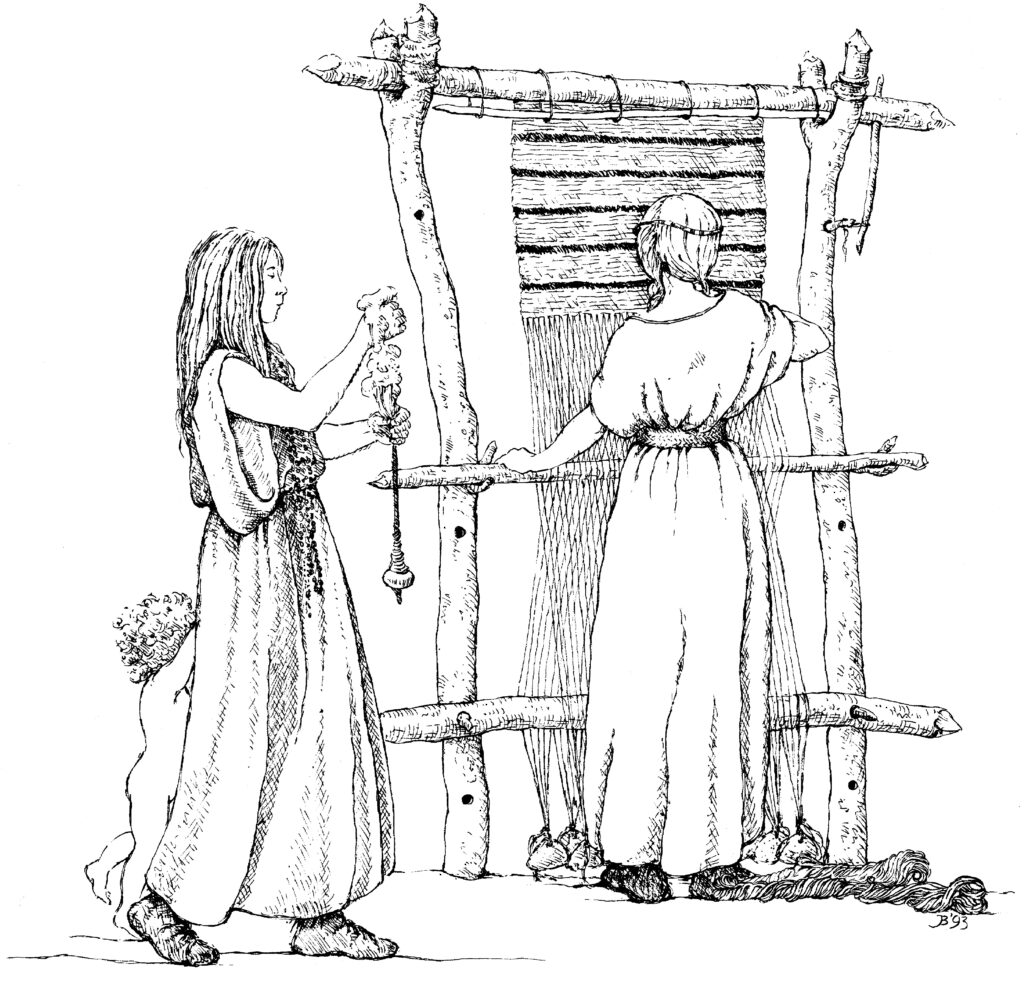
Almost nothing is known about furniture, but the inhabitants were very able woodworkers and had the skills to make beds, tables and seats if they wanted them.
Every house had a central hearth, sometimes with a small bread oven just to one side. There would have been a large collection of pots for cooking and food storage together with many wooden containers such as stave-built buckets, turned bowls and steamed bentwood boxes. Metal containers such as cauldrons or bowls were rarer and more precious. A lot of these things were decorated with elaborate designs that may have had symbolic meaning.
Each family would have had a range of everyday tools and equipment, including looms for weaving cloth and rotary querns for grinding grain for bread. Woodworking and metalworking were taking place across the settlement.
How long would a roundhouse last?
Recent new dating evidence from the Lake Village site suggests that each house would only have lasted for about a decade. One of the roundhouses was rebuilt nine times over a period of roughly 100 years. The whole village was occupied for about 150 years and had a maximum of about 14 houses in use at any one time.
We’re hoping our roundhouse will last around 10 years!
Learn more
- Download our information sheets on the Roundhouse, Lake Village and Bulleid and Gray
- Watch a film about the recent excavation of the Lake Village
- Watch a digital recreation of the settlement in its wetland landscape