
Devon Archives and Local Studies has been steadily transforming its extensive range of paper catalogues into digital records. Richard Manning, Archives and Local Studies Assistant has begun a project to digitise collection 63/2, documents of the Ley family of Trehill. These records are now available through the Devon Archive Catalogue.
The Project
As part of a wider effort by Devon Archives and Local Studies over recent years to convert our large range of paper catalogues into electronic format, for the past few months we have been working on making collection 63/2, relating to the Ley family of Trehill, available online via the Devon Archive Catalogue. As well as transferring existing entries, this process also provides the opportunity to expand and complete earlier attempts at cataloguing one of the most important features of the collection, the Ley family’s extensive correspondence, with a particular focus on optimising online searchability.
Although work remains ongoing at the time of writing, this short series of two blog posts aims to draw attention to this historically valuable, yet often overlooked, collection. This first instalment aims to provide a brief introduction to the Ley family, and a flavour of the collection as a whole, with the second concentrating specifically on the Leys’ correspondence.

63/2 and the Leys of Trehill
63/2 first entered our collections via the East Devon Record Office – a predecessor organisation of Devon Archives and Local Studies – in a number of accessions between 1963 and 1976. Although containing material from the 16th to 20th centuries, the 63/2 collection’s coverage is richest for the period from the later 18th to early 19th centuries, corresponding with arguably the height of the Ley family’s importance in local and national life.
A key milestone in the rise of the Leys’ fortunes can be seen in the purchase in 1745 by John Ley senior (d. 1775) of Trehill, in the parish of Kenn, a country seat which would remain in the family’s possession until the 1950s. It was, however, in the time of John senior’s children and grandchildren that the family really came to prominence. Becoming Clerk Assistant of the House of Commons in 1768, and rising to Deputy Clerk in 1797, John senior’s son, also called John (1732-1814), initiated a connection between the Leys and the clerk’s department of the House of Commons which would be continued by various members of the family until the early 20th century. Most notable of all in this regard was John Ley’s nephew, John Henry Ley (1778-1850), who, over the course of a career lasting almost 50 years, rose through the various ranks of the department: having joined as Second Clerk in 1801, he was made Clerk Assistant in 1814, and finally attained the role of Clerk of the House of Commons in 1820, a position he would hold until his death.
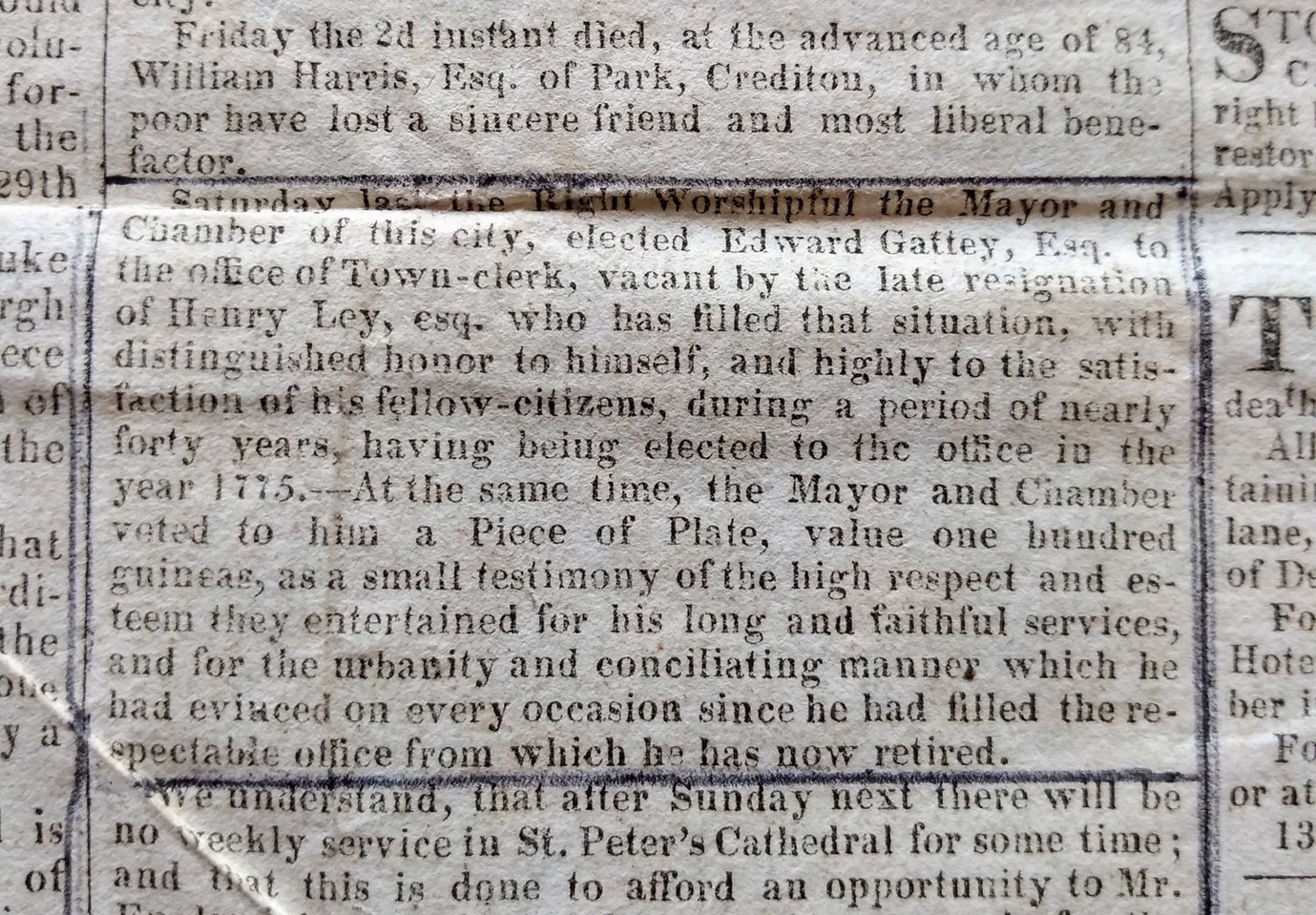
Other members of the Ley family were also of considerable local significance during this period. John’s brother (and father of John Henry), the lawyer Henry Ley (1744-1824), for instance, not only played an important role in managing the Leys’ own estates, but acted as a trusted advisor to prominent Devon families such as the Parkers of Saltram and Courtenays of Powderham, in addition to serving as Town Clerk of Exeter from 1775 to 1814.
A Flavour of the Ley of Trehill Collection
Although the 63/2 collection is too extensive to be described in detail in the space available here, the following aims to give a flavour of some aspects of the collection likely to be of particular interest to researchers.
Deeds
Deeds and associated papers form one of the cornerstones of the collection, recording various property transactions in a range of parishes spanning the 16th to 20th centuries. As might be expected, Kenn is particularly well represented (see, for instance, 63/2/1/1/1-968), though there is also good coverage of property in the parishes of Zeal Monachorum (63/2/1/5/1-53), Exminster (63/2/5/1/1-46), and Newton St. Cyres (63/2/1/7/1-31), amongst others, including some outside of Devon (for example, 63/2/5/2/1; 6; 10a-b; 12 and 14).
As well as chronicling day-to-day property transactions, certain deeds in the collection mark key moments in the history of the Ley family, such as those relating to the purchase of Trehill by John Ley senior (63/2/1/1/55-56), and the Marriage Settlement entered into before the marriage of John Henry Ley to Frances Dorothea Hay (1789-1875), daughter of the 7th Marquis of Tweeddale, in 1809 (63/2/3/3/8).
Financial Records
The 63/2 collection contains a wide range of financial records relating to the Leys and their estates. A series of rent books (63/2/9/2; 3 and 6), for instance, covering the period 1756-1794, not only record the receipt of rent from tenants, but also various items of expenditure including land tax, poor rates, and other bills. For the 19th and 20th centuries, a number of rentals also survive, broadly covering the years 1819-26, 1888-89, and 1911-22 (63/2/12/1-15). Somewhat easier to navigate than the earlier rent books, these provide a valuable overview of the Leys’ tenants and landholdings, and a vivid insight into the history of the area.
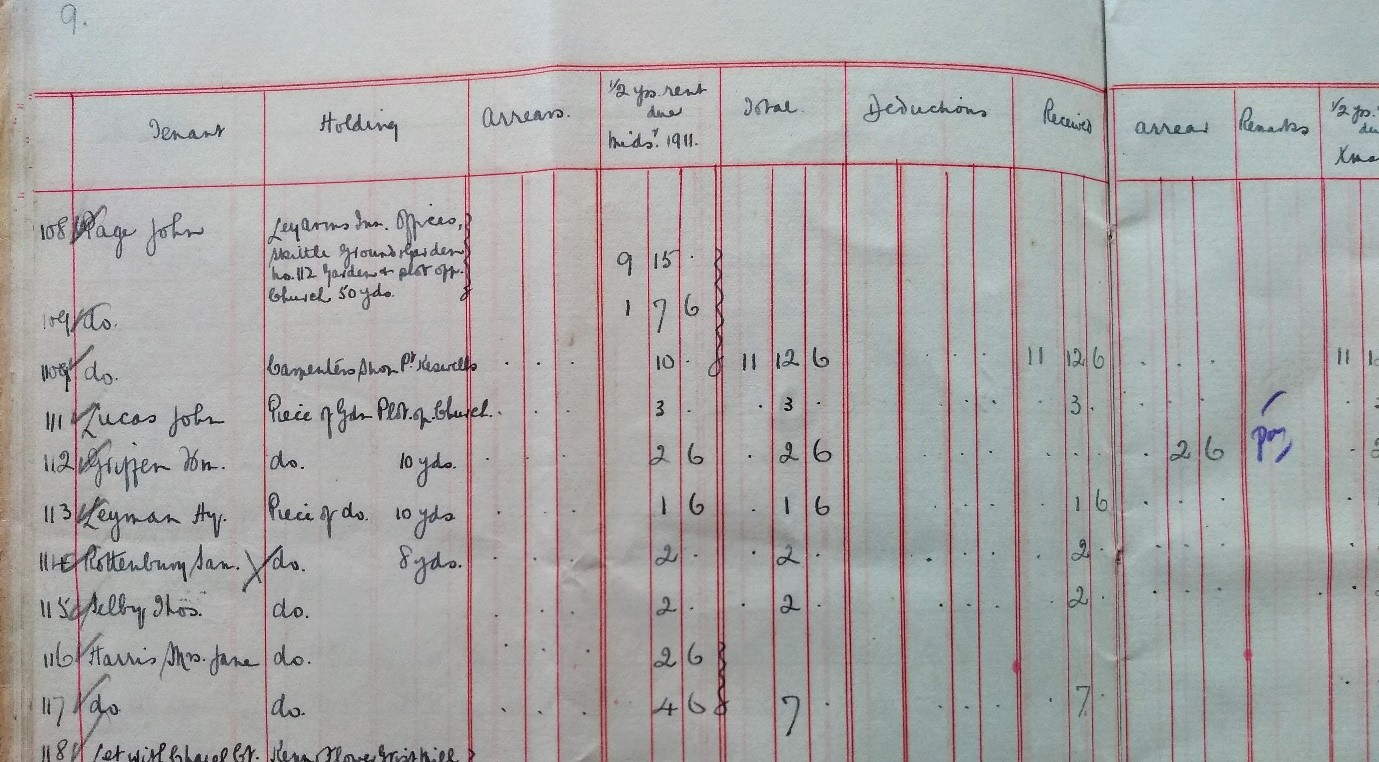
Other financial records in the collection chronicle the Leys’ dealings with a variety of tradespeople including, for example, masons and carpenters undertaking work at Trehill (63/2/4/16-21; 63/2/9/35). Account books (such as 63/2/9/8 and 22) kept in relation to John Ley’s London establishment are also of particular interest in itemising the various expenses associated with life in the capital, such as the payment of servants, as in one 9 May 1785 entry, signed by Elizabeth Beach, which acknowledged receipt ‘of Mr Ley four pounds fourteen shillings & sixpence for ½ years Wages & Tea’ (63/2/9/8).
Personal Records
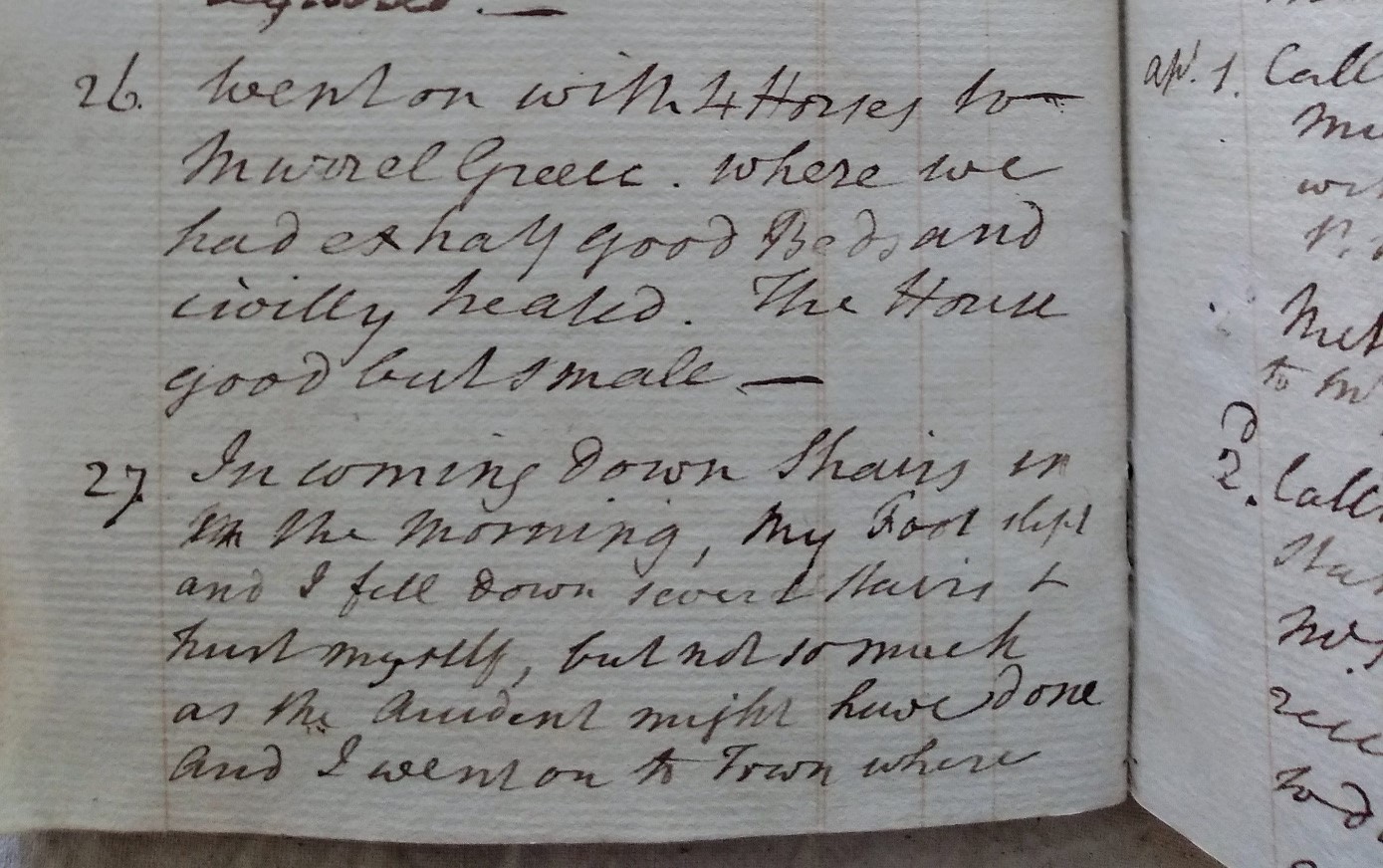
Whilst many of the records in the 63/2 collection relate to the business of estate management and the family’s professional activities, it is also possible to gain some sense of the Leys as people, as in the diaries which Henry Ley kept – along with financial accounts – during visits to London from 1793 to 1819 (63/2/9/11-12; 14-16; 18; 20-21; 23; 29; 37 and 39). In them, we find intermingled not only details of his various professional activities – including discussions about leases and visits to the Stamp Office – but also records of more personal activities, such as dinners with friends and family, or visits to the theatre and opera, and even such sympathetic insights as his relief at not being more seriously hurt following a fall down stairs in March 1818.
These more intimate glimpses of the family can be found elsewhere in the collection, too. One such example is a touching inscription in what appears to be John Ley’s hand on one letter in the collection dated 9 July 1775 (63/2/3/4/2), noting that ‘I have kept this Letter because it is of Mrs Parkers hand writing’, and it is possible to conjecture that it would have served as a poignant reminder of its writer following her untimely death only a few months later, in December of the same year. A compelling illustration that for the Leys recordkeeping could not only be a practical, but also at times an intensely personal, activity, such a comment also clearly demonstrates the profound importance of correspondence during that period, and it is this particularly rich component of the Ley of Trehill collection that will be explored in the next blog.