
The painting Chance Encounter by Rachel Reckitt gave rise to the exhibtion title and lead imagery for the autmn/winter exhibtion at the Museum of Somerset. Here, we look at that striking painting in more depth.
Chance Encounter
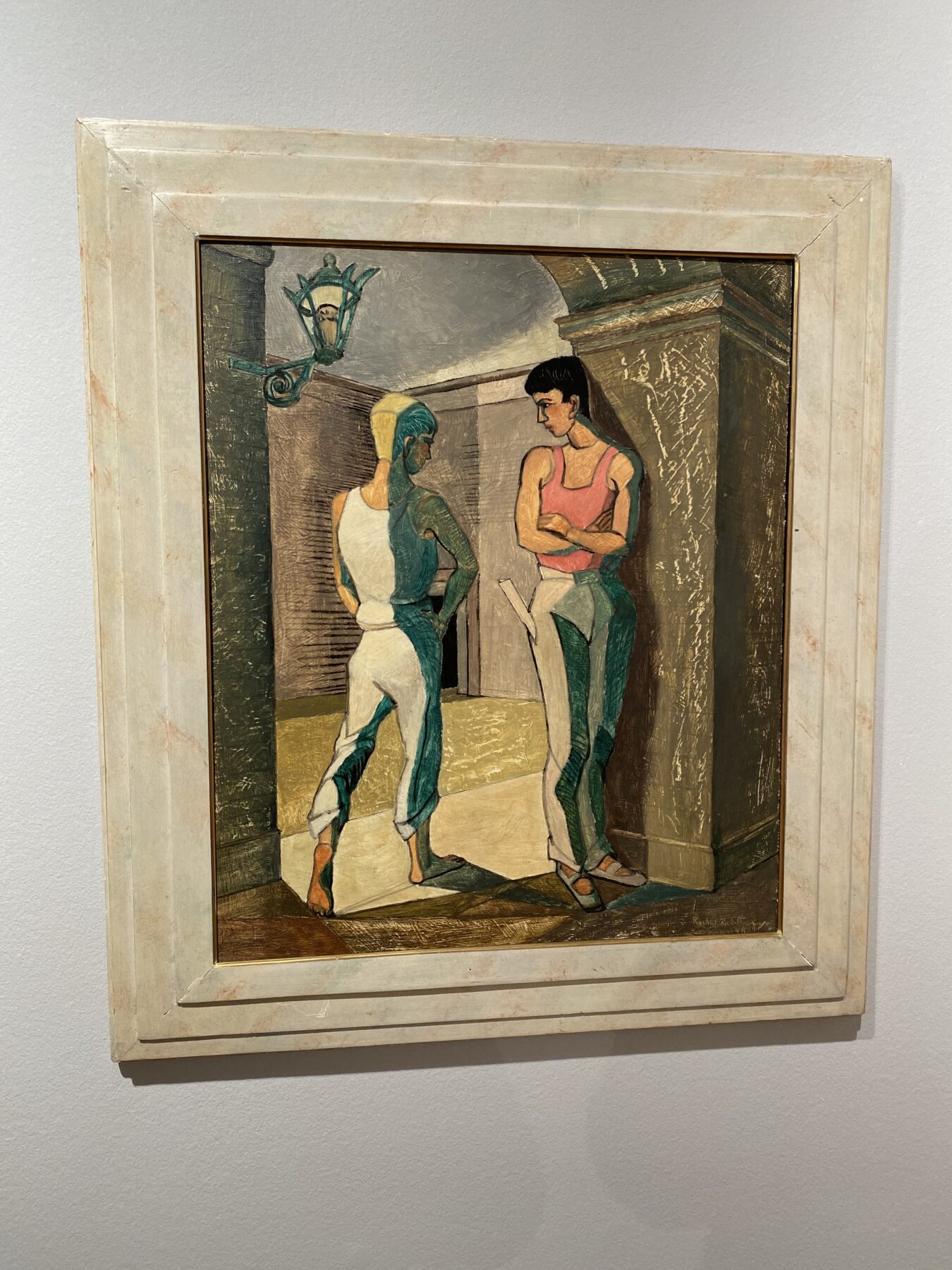
This painting offers a glimpse into the lives of ordinary people, as many of Reckitt’s artwork do, revealing Reckitt to be a shrewd observer of human life. Chance Encounter depicts an intimate moment between two figures under an archway. One figure is mid-stride and the other leans nonchalantly against the archway, gaze firmly focused on the barefooted person walking by. As there is no other sign of human presence, the focus is solely on the visual dialogue or connection between these two figures who exist in their own space. The gender of the two figures is ambiguous, with Reckitt choosing to accentuate the hourglass body shape, dropped hip stance, softness of features and blushing cheeks, alongside strong shoulders and muscular form. The clothing also gives little away. This gender ambiguity is not unusual in Reckitt’s work and it is interesting to note that she often used the term ‘figures’ in her titles rather than referring to a specific gender, allowing for a multiplicity of interpretations. The intensity of the exchange and the mystery that surrounds it also invites the viewer to ask questions about who these figures are and what their relationship might be. It is a strikingly modern and quietly beautiful moment of connection between two people who have been immortalised in paint by Reckitt.
The lack of artistic statements may be frustrating for the historian, however, it is an act of generosity for the viewer as it allows a variety of readings and interpretations. The way we interpret the artwork has not been controlled or dictated by Reckitt. Instead it is open to different narratives and approaches.
The geometry of the figures, levels of abstraction, use of strong lines in Chance Encounter are all characteristic of Reckitt’s paintings of this period. The black horizontals on the wall to the left of the composition; the sharp black lines outlining the figures draw parallels with her earlier wood engravings which by their nature have a strong use of lines within their compositions.
-
Visit the exhibition, ‘Chance Encounters: The Art of Rachel Reckitt’ , on display at the Museum of Somerset until 15 March 2025.
-
There is a series of art tours supporting the exhibition. See our What’s On pages for more info.
-
Find Reckitt’s community artwork on a tour through Somerset. Read the blog to find out where to look.
-
Read the rest of the behind-the-scenes blog series.