
We’ve spoken with two wool artists from our Spinning a Yarn exhibition, Jade Ogden and Liz Clay to find out why wool is such an important fibre. Both artists work with wool in differing ways, yet both are innovative artisans who make beautiful and sustainable textiles from this amazing, natural fibre. Spinning a Yarn celebrates wool through bringing together historical artefacts related to its production alongside the work of contemporary artists and makers created using wool.
Jade Ogden
Jade Ogden is a handweaver based in the Mendips. She studied handweaving at the Handweaver’s Studio in London and has been developing her practice over the last decade. Jade’s work uses only materials that can safely be returned to the soil at the end of their long life, providing nourishment to the earth from which they originally grew. She primarily works with undyed, regeneratively farmed Shetland and Romney wool, sourced less than 10 miles from her home.
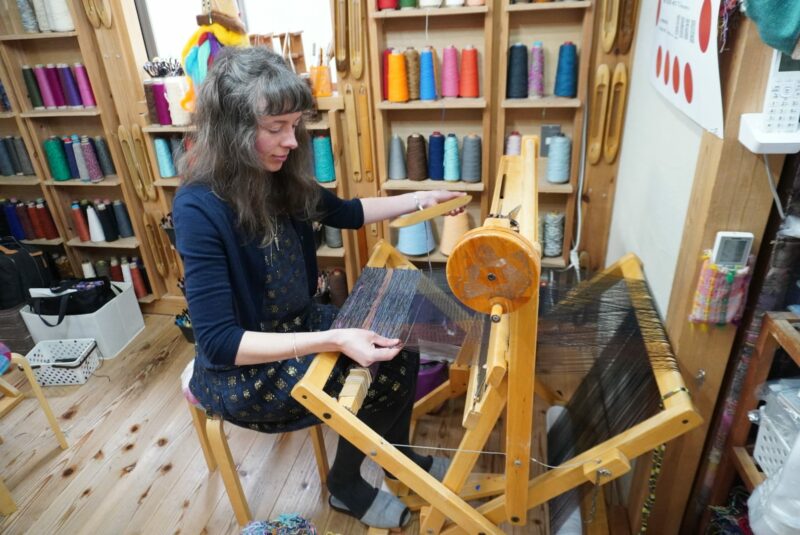
Jade Ogden
The Importance of Wool
I love working with wool for many reasons, but primarily because it is a regenerative resource that we have abundance here in Somerset – and across the UK. It is a fibre that is constantly being produced naturally by sheep and it has amazing properties that keep us warm whilst allowing our skin to breathe. I love working with it and feeling the lanolin moisturise my hands as I weave – it also has a beautiful comforting smell.
Selecting the Wool
I source my wool from Fernhill Farm, which is less than 10 miles from my home. I select the wool for its softness and natural colours – I love the contrasts found in working with pale greys and deep browns – it enables me to almost ‘draw’ my designs on the loom, with no added colour needed.
Somerset’s Importance
It’s important to me to work with fibres that are produced as locally as possible, so it made sense for me to source wool from Somerset. I am eager to demonstrate the potential of local fibres and production for clothing and furnishings, as an antidote to fast fashion and as an example of fashion that is instead beneficial for the planet. As a member of the South West England Fibreshed, I’m so pleased to be among a community of people working with this aim. Luckily, I happen to live very nearby to the wonderful Fernhill Farm, who produce beautiful, regeneratively farmed wool – and I can buy it already spun from them too!
The Wool Life Cycle
At Fernhill, they follow a regenerative model of farming and care for the sheep, which actively increases the biodiversity of the area. This means that during its growth, wool is benefitting the land. When it has been woven and made into to an item, it will last for many years – and even at the end of its life it can be safely returned to the earth to give nutrients to the soil. It is a fibre that gives back to the planet at every stage of its life.
Liz Clay
Liz Clay is a practitioner and researcher of handmade felt based in the Mendips. She uses innovative felt making techniques to create haute couture for leading fashion houses including Stella McCartney and Givenchy. She studied textiles at Bath School of Art and Design and her PhD investigated the creative potential of British ‘waste’ wool for fine craft felt making. Her work is held in collections including the Crafts Council and Bradford College Textile Archive.
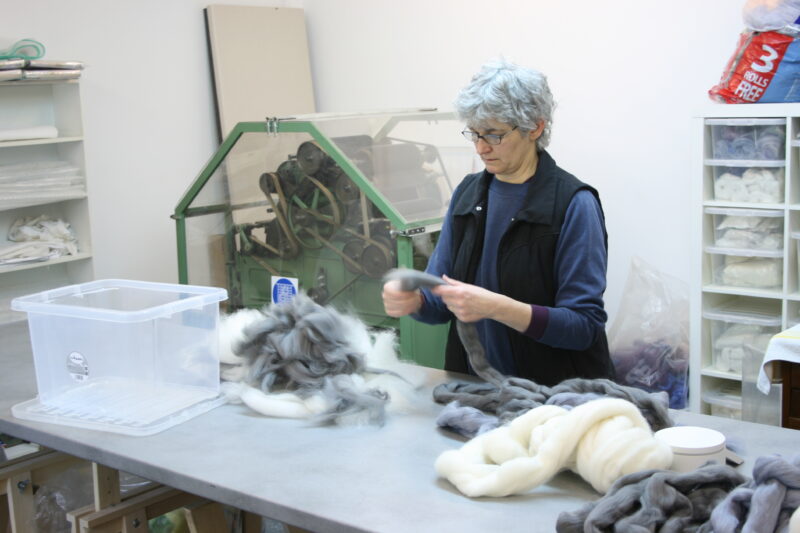
Liz Clay
The Beginnings of the Journey
I discovered felt making in the ‘90s at the same time as weaving for a BA in textile design. It was not love at first sight but following a six month residency in Norway I noticed felt products in the shops and researched the felt makers. This experience inspired me to experiment and explore felt making and to develop my own ideas with wool felt.
Tools of the Trade
I am fortunate to own a sample industrial carding machine bought with funds from a Crafts Council Development Award. It changed my life! It speeds up the carding process and produces the most amazing tonal qualities for my designs.
The Creative Process
I am very focused on the end result, whilst I also enjoy the creative process. I allow myself to make mistakes and be experimental with the creative process. That can be very enjoyable.
Most Memorable Creation
Working for Givenchy on their 2005 and 2006 haute couture collections, the challenges were enormous and the results so gratifying. I was asked to incorporate feathers into the hand felted wools. The final piece was featured in Vogue. The following year I created fabric for a jacket with hand felted guipure wool lace decorative elements. The process I developed to achieve this I have used in my own collections.