
Dr. Joanne O’Hara, Heritage at Risk Manager for Somerset Council, introduces a project to breathe new life into a stunning relic of the county’s proud manufacturing past.
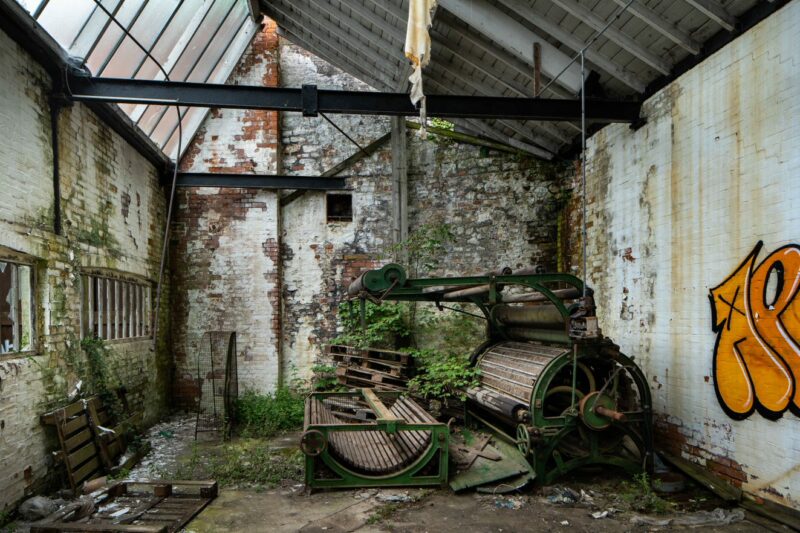
Nestled on the edge of Wellington, Toneworks is an exceptional example of a textile finishing mill and dyeworks. Containing arguably the best-preserved collection of this kind of industrial machinery in the country, this is where Khaki dye was first invented and where ‘puttees’ – the gaiters worn by soldiers in the trenches – were made to be exported across the globe.
Heritage At Risk
Developed in the 18th century, Toneworks was built adjacent to a tributary of the River Tone to take advantage of the plentiful supply of clean water needed for washing and dyeing woven fabrics. The waterways also initially powered the machinery used for weaving and dyeing, to be replaced later by steam and eventually electricity. At the height of their productivity in 1915, Toneworks – and its associated manufacturing base, Tonedale Mill – employed some 5,000 people and had a turnover comparable to around £350m at today’s values. Both are Grade II* listed and on the Historic England ‘heritage at risk’ register.

Faithful Restoration
Toneworks was acquired by Somerset Council in 2020. Using a substantial development contribution and generous funding from the DCMS, Historic England and Wellington Town Council, it has spent £1.8m on urgent decontamination and stabilisation works. This work has been complemented by painstaking and faithful restorations of some of the more evocative interior spaces. Although there is still much to be done, the investment to date has excited huge interest from the community, commercial developers and environmentalists. Securing parts of the building in this way is allowing new uses to be explored and a meaningful future for this iconic local landmark to be reimagined.
Welcoming the Community
The South West Heritage Trust is supporting the Council to build relationships with new funding partners and to deliver ‘Unravelling Toneworks’ – a series of public tours (fully booked) and talks, running throughout the summer and autumn of 2023. We’re delighted to be welcoming the local community back, after more than 20 years of decay and dereliction, to help breathe new life and hope into this stunning relic of Wellington’s proud manufacturing past.
IMAGES: Claire Fear/Wellington Mills CIC