John Booker, a retired archivist, has been volunteering for the Devon archive service since 2011. In 2013 he assumed responsibility for cataloguing our Quarter Sessions records. Here he reflects on the last ten years.
Ten years have now passed since I assumed responsibility for continuing the work of Bob Bennett, an archivist funded by the National Archives. We have been jointly responsible for cataloguing the ‘Quarter Sessions bundles’, the papers rolled up by the Clerk of the Peace after each Sessions. Over 12,000 items between 1734 (the first year in which the documents are mainly in English) and (currently) 1778 have now been catalogued.
The Quarter Sessions courts had both administrative and judicial responsibilities. The latter came first and survived until 1971, while the administrative side passed to County Councils in 1889.
How is the material useful? Family historians have access to new information about how their ancestors conducted themselves. The parish historian receives an overview of local criminality, employment, population issues, the role of the parish officers and the state of roads and bridges. The constitutional historian can examine the relationship between the county, the Crown and Parliament.
There were other Quarter Sessions courts in Devon, and a significant challenge came from Tiverton in 1774 when a small group charged with ejecting a man from his house argued that, as the borough was theoretically entitled to have the jurisprudence of the county in microcosm, their case should be heard locally. The County brusquely rejected this but the claimants would not back down and the Clerk of the Peace, Christopher Gullett, struggled to contain the fall-out over several years.
Indeed, the relationship of the Clerk of the Peace with the magistracy is another useful revelation. The patrician John Fortescue apparently got along with everyone but Gullett was different. He practised also as an attorney-at-law in Tavistock and never compromised his legal rigidity to accommodate the gentry. The photograph below (Figure 1) shows a letter from the rector of Mary Tavy, part of a correspondence which degenerated from normal solicitations about family health, to an accusation by the rector of downright rudeness. Yet the only issue was how to lift an indictment on the parish of Mary Tavy for the bad state of a highway which had since been repaired.
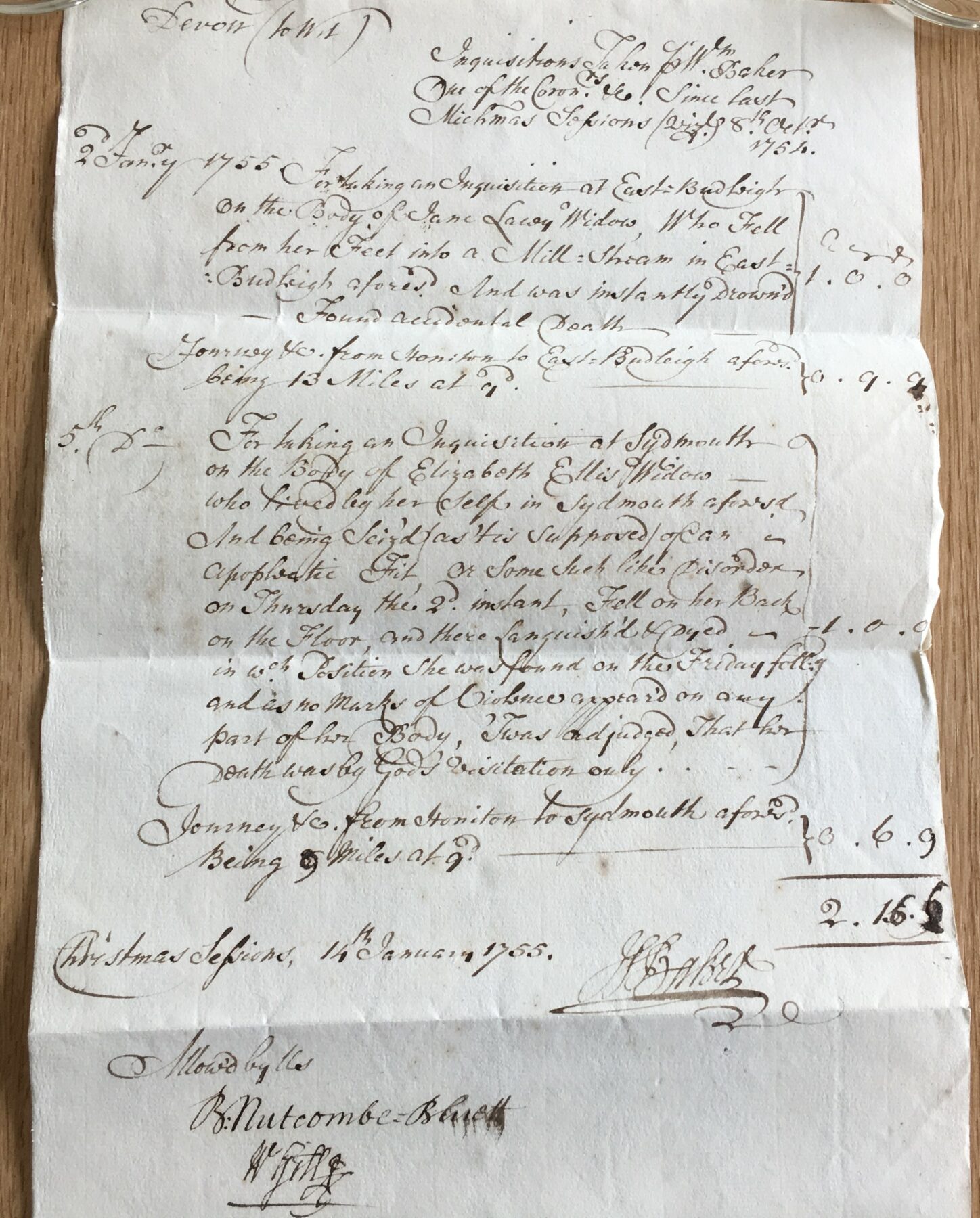
The other photograph (Figure 2) is an extract from a coroner’s return. From 1752 the county coroners reported their inquisitions to Sessions in order to claim their travelling expenses. Their reports are variable in detail and sometimes not for the squeamish.