
The earliest documents to be found within the receivers’ vouchers are two accounts dating to the summer of 1549. These were first discovered by Professor Mark Stoyle from the the University of Southampton. Despite their unremarkable appearance and their scrawling, often illegible script, these accounts are significant in revealing contemporaneous responses to the Prayer Book Rebellion, one of the most tumultuous chapters in Exeter’s history.
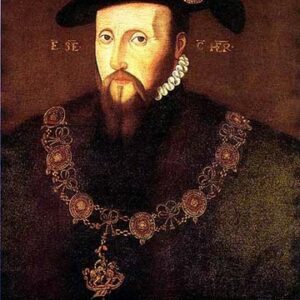
Edward VI ascended to the throne in 1547. Then a boy of only 9 years old, a regency council was appointed to rule collectively during his minority, comprised of the 16 executors of the will of Henry VIII. In the days following, however, the overwhelming majority of the council turned to the new king’s uncle, Edward Seymour (pictured), to rule as Lord Protector of England. Seymour’s brief but eventful rule as Protector was characterised by new religious policies that promulgated iconoclasm and the use of English in liturgy. These polices proved deeply unpopular in large parts of the country and, following the introduction of the Book of Common Prayer in June 1549, open revolt broke out in Devon and Cornwall.
The rebellion, sometimes known as the Western Rising or the ‘Commotion’, began in the small village of Sampford Courtenay. The rebels quickly swelled in number and in early July, around 2,000 approached Exeter. The mayor and the Common Council, ‘forecastinge the perelles wh[hi]ch mighte in such a cause ensewe’, as John Hooker later wrote, responded with a series of defences sought to protect the city.
The Authors of the Accounts

The two accounts within the receivers’ vouchers detail some of these defences. The first of these is that of William Hurst (pictured), alderman, listing expenditure delivered for the city since the 9 July. The second is the account of John Blackaller, mayor, made on the 23 August. Blackaller in particular was no stranger to opposition to religious reform. When, during the 1530s, the rood loft was to be pulled down in St Nicholas’s Priory, Blackaller found himself on the receiving end of a blow from one of the women protesting its removal. He may have been one of the men within the Common Council who, so Hooker claimed, was ‘well affected by the Romyshe religion’; yet despite any sympathies to the rebels’ cause, he and his brethren, respecting their duty to God, king and country, refused to join the rebels.
The Accounts
From a historical perspective, the accounts of Hurst and Blackaller are remarkable for their insight into how Exeter defended itself during some of the crucial stages in the rebellion. Providing an inventory of the items delivered for the city’s defences, they detail payment made to numerous individuals for both labour and items. Elm wood, for example, was purchased from Mr Cary to make a parvis at the walls over West Gate, while 2s. 6d. was delivered for elm boards for the rampart. A large quantity of gunpowder was procured: Blackaller’s account alone detailed some 92lbs for the use of the city. The account of Hurst, meanwhile, listed two bows and four sheathes of arrows from Isaac Belleweter, and 40s. was paid to Harry Mander, steward, to buy more bows.
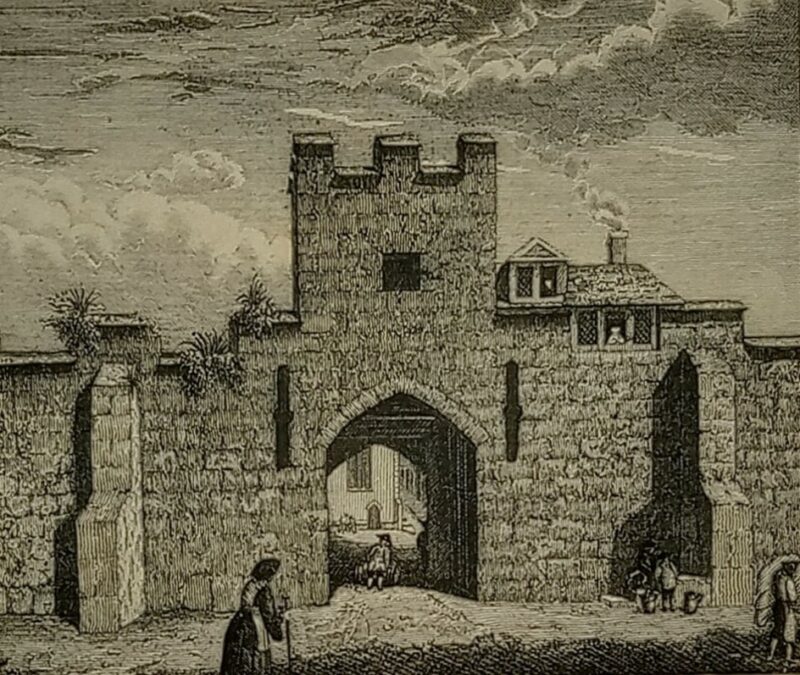
West Gate in the early nineteenth century. The accounts tells us that in 1549, William Hurst paid Mr Cary 6s. 8d. for eight boards of elm to make a defensive parvis at its walls
Consideration was taken for the punishment awaiting the rebels, too, with 40s. paid for timber to make the gallows, and a further 12d. for the first pair of gallows made. These gallows would be put to good use: after five weeks of siege, the rebels were defeated at Exeter and John Russell, the Lord Privy Seal, approached the city walls early on the morning of the 6 August to relieve the beleaguered citizens. In a cruel and ironic move, one of the rebels – the vicar of St Thomas, Robert Welsh – was hanged in his priest’s vestments, along with rosary beads and a holy bucket, from the gallows erected on the steeple of his church. It was a better fate than some of the rebel leaders, such as the Cornish gentleman Humphrey Arundell: after being taken to London to be tried, they were hanged, drawn, and quartered at Tyburn, concluding a strange and turbulent summer in the West Country.

Hurst and Blackaller’s accounts have now been catalogued and are available to view in the searchroom at the Devon Heritage Centre. For those unacquainted with sixteenth-century palaeography, however, full transcriptions of these accounts may also be found in Mark Stoyle, Circled with Stone: Exeter’s City Walls, 1485-1660, copies of which are held at the heritage centre.
Image credits: William Hurst, Royal Albert Memorial Museum and Art Gallery, Exeter: 163/1998