
Introduction
The third blog in this series concerns a series of four small bundles, mainly in the hand of the city’s Overseer, formerly stored in Box 2 of the Receivers’ vouchers. Commencing in July 1646 and continuing to the autumn of 1647, these bundles record the extent of the damage in Exeter during the Civil War, and the Chamber’s efforts to rebuild and repair the city in the months following the Royalist surrender in 1646.
The aftermath of war
By the time the New Model Army entered the city on 13 April 1646, four days after the terms of surrender were laid out by Thomas Fairfax, Exeter had played host to nearly four years of sieges and skirmishes. Between 1642 and 1646, and principally in the extramural parishes of St Sidwells and St Davids, scores of buildings had been destroyed, trees felled, and trenches dug to improve the defences of the city, firstly against the Royalists, and then – following Prince Maurice’s victory in 1643 – against the Parliamentarians.

But damage to Exeter’s infrastructure at the hands of soldiers and frequent battle had also left their mark, and so after the terms of surrender there was immediate need to rebuild and repair. Many details of this are recorded in the Chamber Act Book for 1634-1647 (ECA/1/3/1/8), but another source of significant value are the bundles of accounts made by George Passemer, recording the accounts and payments made to workmen in restoring the city.
George Passemer
George Passemer was appointed Overseer, or Surveyor, of the city’s works on 9 September 1634, succeeding Robert Sherwood on account of the latter’s declining health and great age. Sherwood had been Overseer since February 1615/6 and a number of his maps have survived, including this vibrant depiction of Exe Island from 1629.
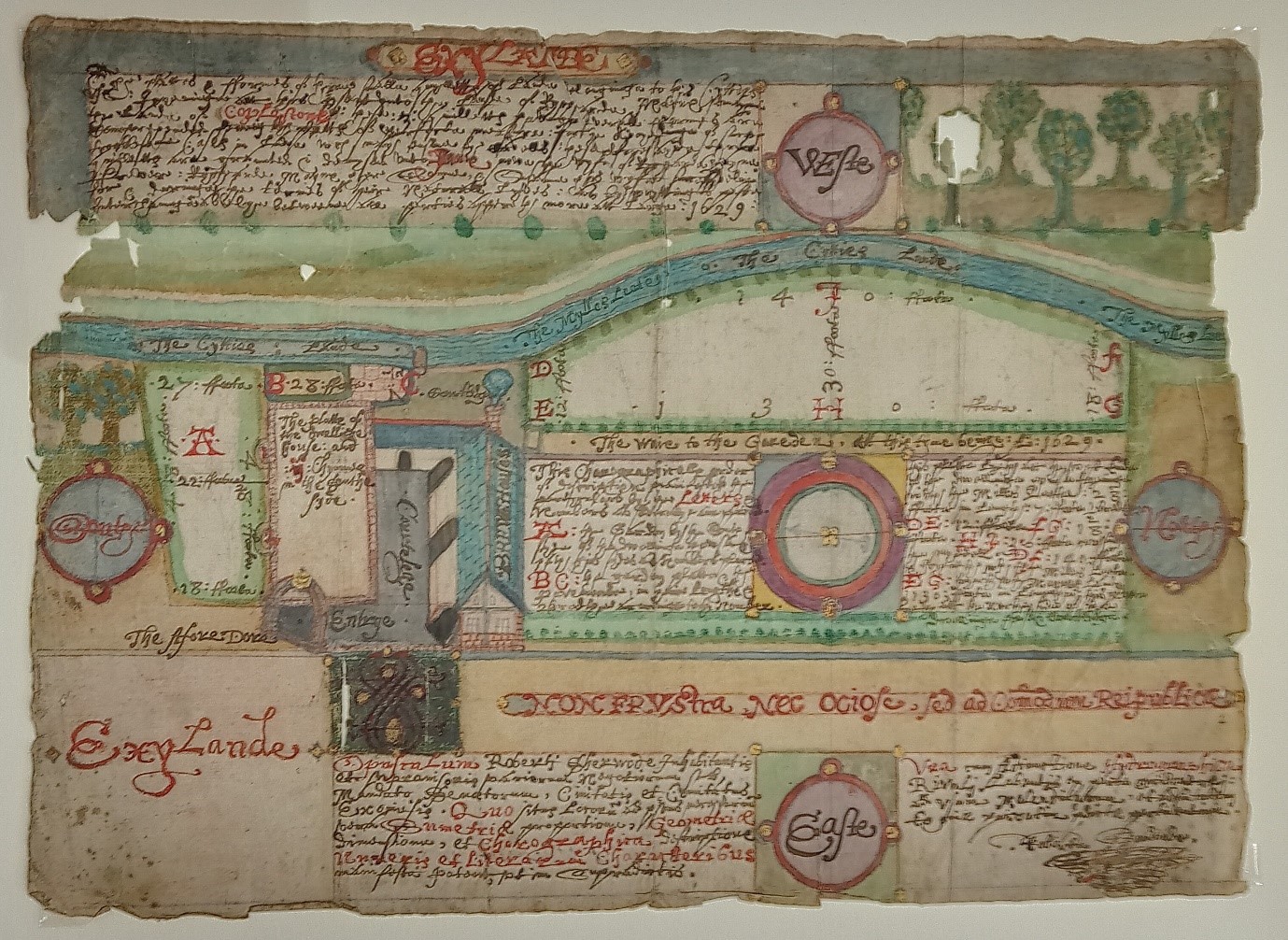
Sherwood’s successor was a known entity to the Mayor and his brethren, if not always for the right reasons. Holding the fee farms of the clothhall and town customs, Passemer had been brought before the Chamber in 1635 for being in arrears on his rent. Despite this, he held the position of Overseer and his salary until his death in or before January 1652, overseeing the work of carpenters, joiners, smiths and masons in repairing the city’s infrastructure.
The accounts
Passemer’s bundles begin in the summer of 1646 when Lewes Grinslade, carpenter, and his company were paid for amending the city’s stock. From here, distinct periods of work undertaken emerge, with much of the initial efforts in the summer of 1646 being focused on the city’s waterworks. By autumn, work had shifted to the Guildhall, and on 8 October 1646, the Chamber Act Book recorded that the Receiver was, ‘with all convenient speede’ to ensure that the backgrate, glass, and ceiling be repaired. The glasswork was undertaken by Nicholas Seeley, who was paid £2 19s. 3 ¾ d. on 24 October for repairing the broken glass in the Guildhall and for making new glass. Five months later, on 13 March 1646/7, Seeley was paid an additional 19s. 10d. for repairing the glass in the Guildhall ‘broken by untoward souldiers’, including 3s. for 4 feet of new glass and 15s. 10d for 152 quarrels. On 20 March, 5 joiners were paid £1 11s. 2d. for amending the ceiling in the Guildhall ‘broken upp and spoyled by ill affected souldiers’, and on 27 March and 3 April, Mrs Joane Aclande, widow, and Mr Anthony Mitchell, were paid respectively for fine green fringe and kersey for the benches where the Mayor and his council sat.
One of the more pressing tasks, however, was to repopulate the city with trees. On 10 December 1646, Passemer paid £3 4s. 4d. for 53 young elms brought from Newton, Shobrooke, Upton Pyne and Exminster. These elms were to be planted at the Bonhay, the leafy refuge which had acquired a reputation for un-Puritan activities before the war, and which had, in 1642 and 1643, been cleared of its elms to make wheels and carriages for the city’s defence. Over the course of the winter, further scores of trees were planted in the Bonhay ‘for the benefyte of future ages’, while in the arid summer of 1647, further payments were made to water the young elms.
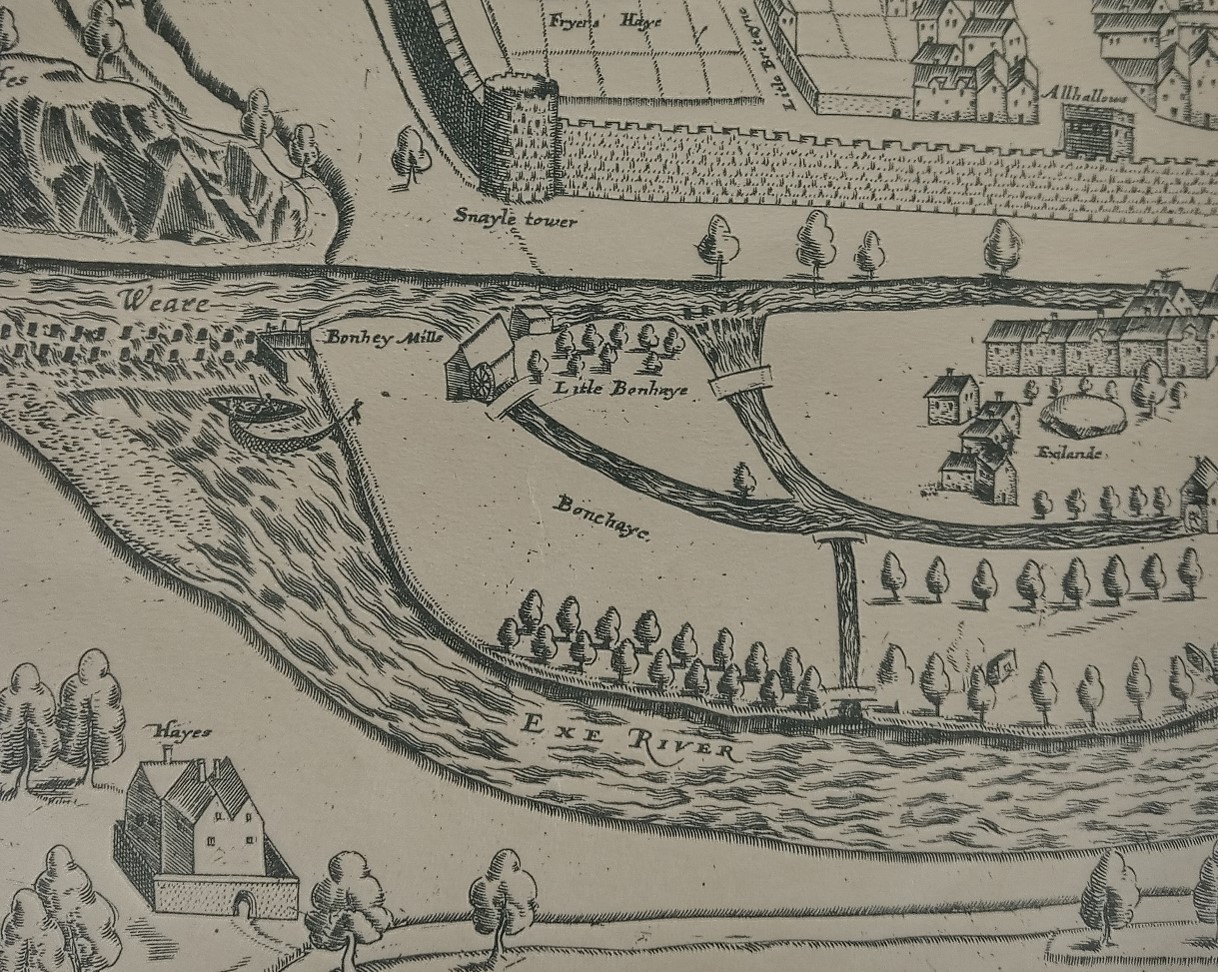
While the great majority of the accounts focus on rebuilding and restoring edificies within the city, evidence of the war’s human cost is also present. Perhaps the most peculiar account of them all was made by Passemer on 9 July 1647, when John Hooper, joiner, was paid 8s. for making a barrow to carry a maimed soldier from the hospital to Cornwall.

Cataloguing the accounts
The bundles of George Passemer have now been catalogued as ECA/3/1/1/3/44, and are available to view in the searchroom. Other documents of interest found within Box 2 are the vouchers of Henry Prigg for payment to the county soldiers and Deputy Lieutenants (ECA/3/1/1/3/38), along with the accounts of Simon Snow, the Parliamentarian-leaning MP for Exeter, for days spent in Parliament in 1647 (ECA/3/1/1/3/43).