
Esther Chant is an Archives Assistant at the Devon Heritage Centre in Exeter, whose work entails cataloguing medieval and early modern documents as well as public service duties. Here, in a series of blog posts, she reveals some of the fascinating material held within the Exeter City Archives.
The Receivers’ Accounts
The receivers’ accounts comprise a remarkable breadth and richness of material, from the early years of the fourteenth century to the abolition of the office in 1835. Comprising rolls, memorandum books, and petty ledgers, they provide key insight into the socio-economic history of Exeter. Perhaps no more is this realised than in the receivers’ vouchers (ECA/3/1/1/3), an underused but fascinating collection.
The Origins of the Receiver
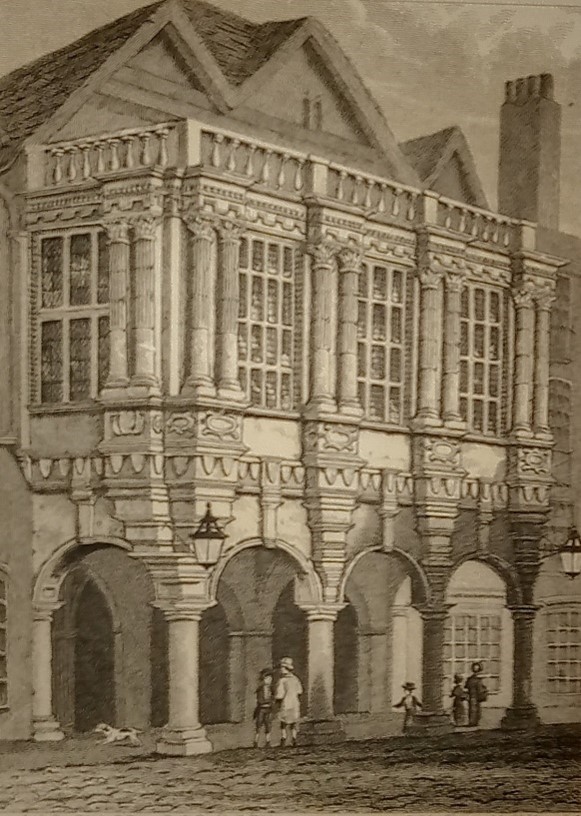
The receiver was one of the highest civic offices in Exeter. According to the Exeter antiquarian Richard Izacke, the origins of the receivership lay in the thirteenth century, when it was decreed that the city would elect four seneschals, one of which would be receiver general of all the city’s rents and revenues. (Picture: The Guildhall, where the Common Council, among them the receiver, met.)
The absence of records and that many of the early lists of elected officials did not distinguish which of the four seneschals was receiver means that most of the receivers’ names prior to 1304 are lost to us. By the mid-fourteenth century, however, the account rolls become more frequently kept, resulting in a near unbroken series of records that continue through to the nineteenth century.
The Receiver’s Duties
The duties of the receiver were numerous, onerous, and often financially draining. During their year in office, the receiver was to collect and gather the rent and revenues for the city, pay the charges, fees, rents, and annuities, oversee the maintenance and repair of the buildings, conduits, and works of the city, ensure the labourers are paid weekly in their works, and to complete a true and perfect account of his receipts and payments by the end of his term of office.
The receivership was not without its drawbacks. Those elected to the position were expected to pay all charges out of his own pocket, with reimbursements not to follow for up to four years later. In 1517, an issue arose when the receiver, Richard Duke, and the bailiffs refused to pay for the extravagant dinners laid out for the elected officials, preferring the fine to the charges.
However, the advantages of the office were considerable. The receiver was entitled to a yearly pension of £20. Perhaps most enticingly, he could also reasonably expect to attain the office of mayor within a few years of carrying out the receivership to full term. By the sixteenth century, almost all receivers became mayor. Despite being a financially draining office, the receivership had the potential to be a very lucrative one.
The Receivers’ Vouchers
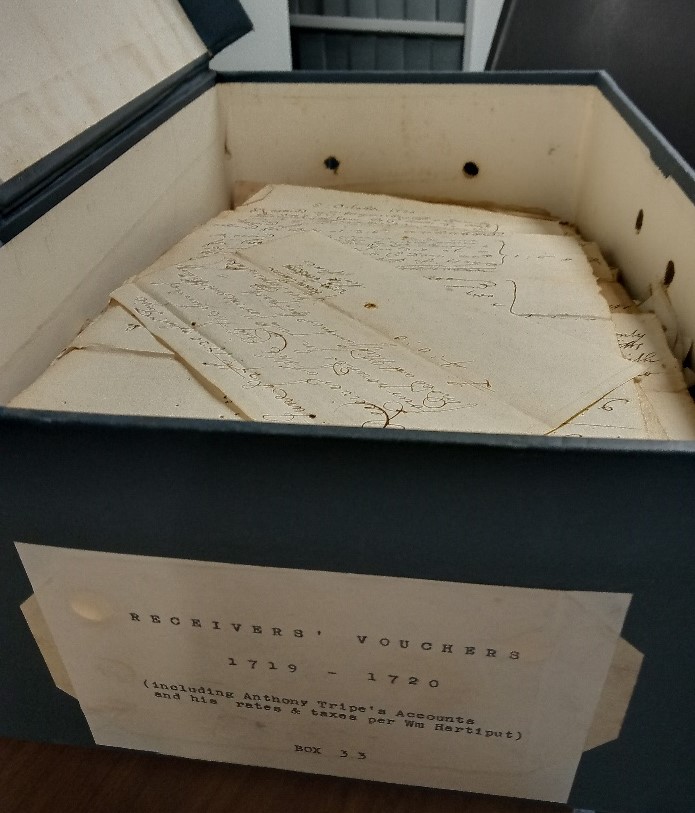
Commencing in 1549, the vouchers are one of the most extensive collections within the receivers’ accounts. The term ‘receivers’ vouchers’ is perhaps somewhat misleading – a great deal of the records within this series are accounts, often followed by a note of receipt. The vouchers are records of men (and sometimes women) paid by the city for their office or labour, as well as recipients of rent payments, interest, and poor relief; accounts of work undertaken across the city; and other such disbursements and expenditure. These records are rather inconsistent and haphazard until the late-seventeenth century, often comprised of large bundles and scraps of paper eaten away at the edges. By the year of Charles II’s restoration, records are more consistently kept.
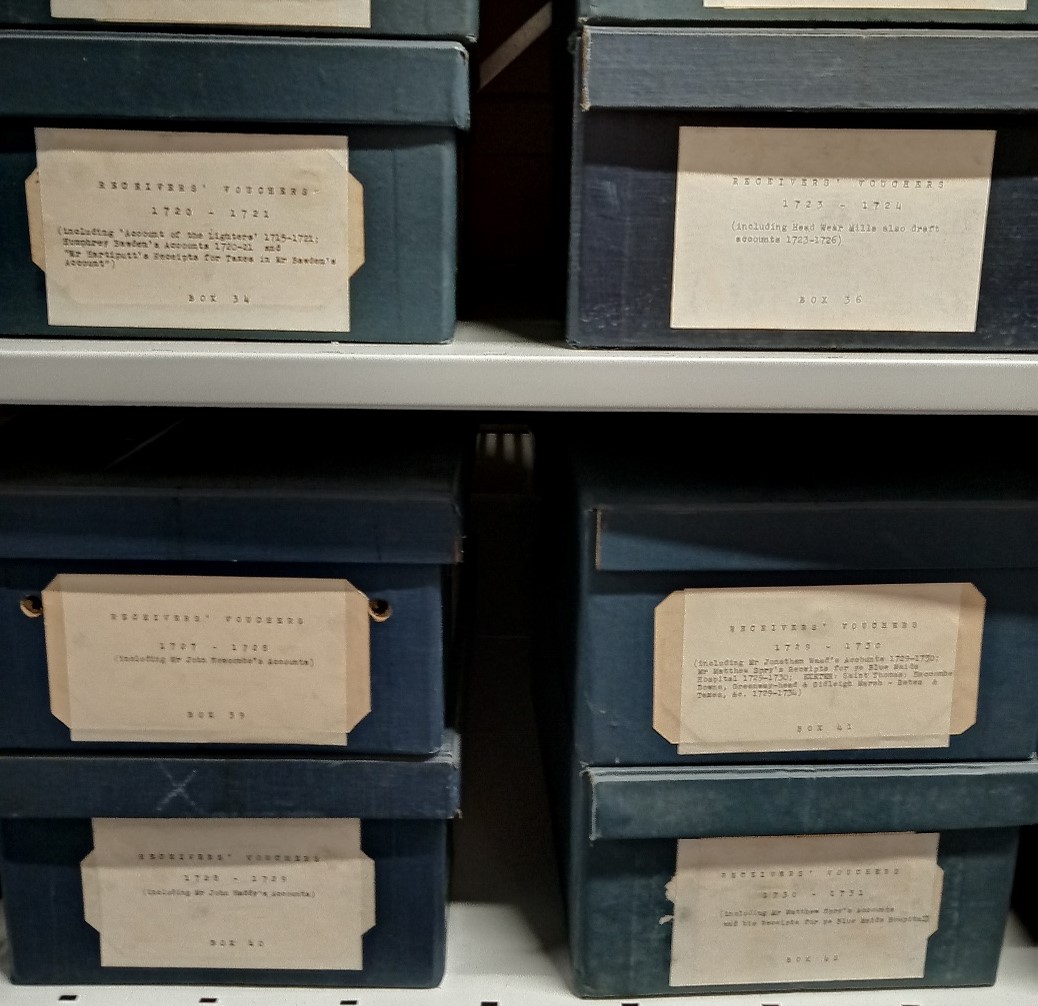
The vouchers are currently stored in 212 boxes at the Devon Heritage Centre. Many of the documents within these boxes are stored loosely, so we’re repackaging the vouchers into archival standard folders.
Esther Chant


Read the Second Blog
Discover the Prayer Book Rebellion

Read the Third Blog
Discover Exeter during the Civil War