
Edward Lear
Many people will be familiar with Edward Lear, the nineteenth-century illustrator, musician, author and poet. Something which may be less well known is that the Somerset Heritage Centre holds a large collection of letters from Edward Lear to his friend Chichester Fortescue (later Lord Carlingford) who was a member of Gladstone’s Liberal parliament, and fourth husband of Frances, Countess Waldegrave. The two men met in Rome in the spring of 1845 when Fortescue was on a grand tour of Europe, and the close friendship lasted until Lear’s death in 1888. The letters, which are part of the family and estate archive of the Strachey family of Sutton Court, just south of Bristol, are accompanied by a range of printed material associated with Lear.

The Letters
Written between 1847 and 1887, the letters recount tales of Lear’s travels around Europe, discussions on common friends and acquaintances, the inspiration for and sale of paintings, international and national events, including the Italian War of Independence, British politics and Lear’s domestic life including his ill-health and contact with siblings. Lear freely expressed his views to Fortescue (who he often addressed as ‘40scue’) and was always pleased to receive a letter from his friend, often chastising him for a long period without.
The letters are filled with illustrations and caricatures, including many self-portraits of Lear. Particular highlights are Lear’s image of himself after gaining weight from lack of exercise, Lear painting with his ‘canvas on a lofty easel, I myself standing on the green seat’, and several pictures of Foss, his cat and long-term companion.

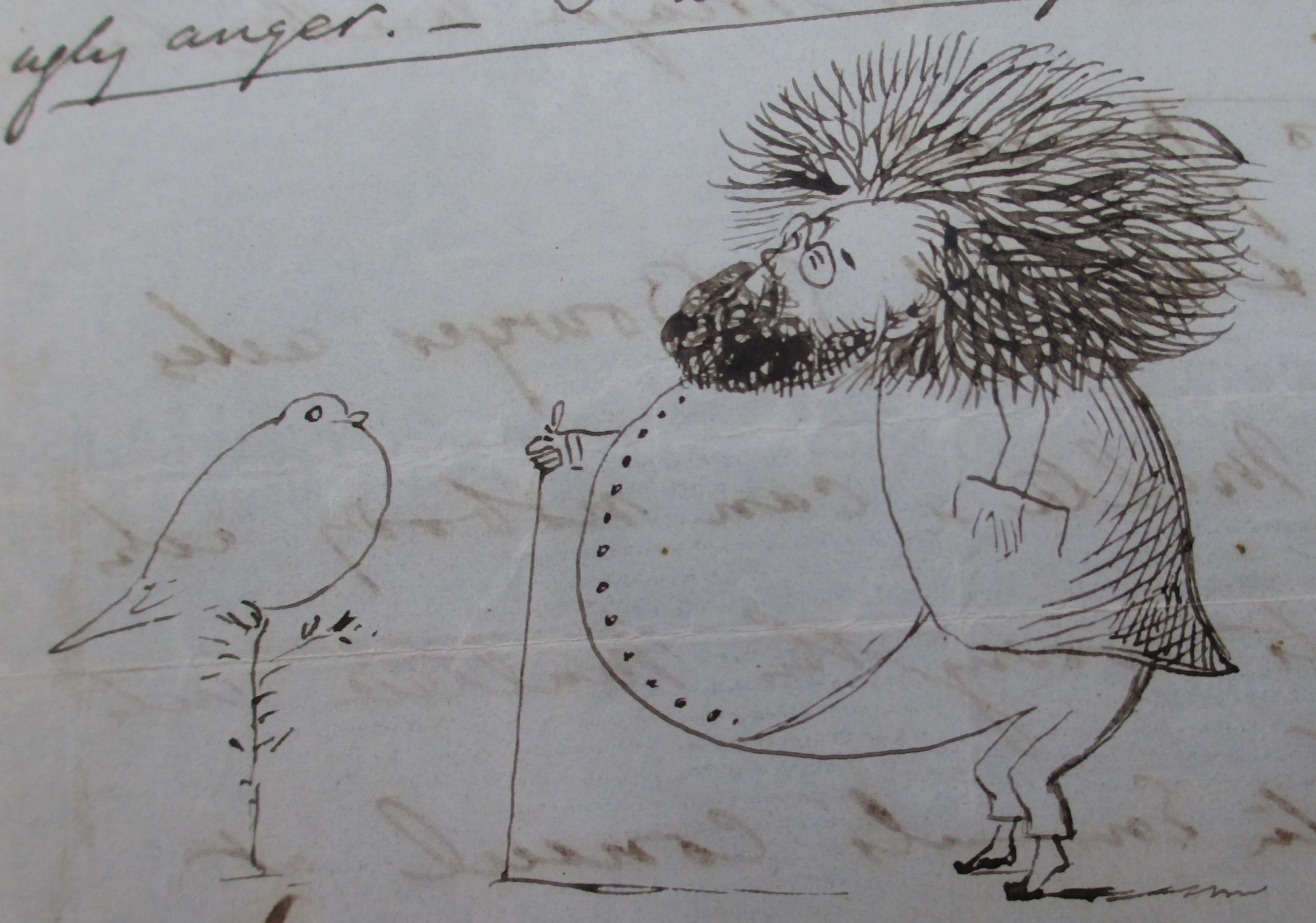

The Conservation Process
The letters comprise a mixture of types of paper. Many are discoloured and have rips and folds to their edges, so they were selected as a priority for conservation work at the South West Heritage Trust’s Conservation Studio at the Devon Heritage Centre in Exeter.
The first step in the conservation process was to undertake a condition survey, during which each letter was individually assessed and the extent of its damage – ‘edge tears’, ‘edge damage’, ‘old repairs’, ‘torn off corner’ – recorded. Many of the letters are supplemented by illustrations, and, where these are present, they were recorded in the survey.
The letters had been stored inadequately in archive folders for a long time, and a decision was made to remove them from these and prepare them for storage in fascicules, which are blank books containing archival quality paper, within which individual letters are placed using a Japanese paper hinge affixed with rice starch paste. Prior to this, where appropriate, localised treatment was applied to folds and tears in certain letters. Each page in the fascicules is numbered to match each individual letter, and only one fascicule of ten letters will be produced at a time for research.