
Working with audio recordings, and the importance of oral history to local culture
Written by Cade Simpson
Working with Audio
In my time working with the Trust as a digital trainee under The National Archives’ Bridging the Digital Gap program, I’ve been on the frontline when it comes to working with both analogue and digital audio. You may wonder what exactly is so difficult or interesting about our work in making more and more of our audio recordings available to the public, and that’s what I’m here to expand on!
For starters, even determining the volume of recordings at our disposal comes with its own set of challenges, especially when you consider that the Trust holds thousands of audio related objects, spread across each of the three South West Heritage Trust archive centres. For instance, we hold over a thousand reel-to-reel tapes, acquired over the past fifty years or so and all of them in varying conditions with unique archive material held on every one of them. Additionally, we still take in regular deposits of audio material of all kinds, with a recent example being a Chudleigh focused collection which contains an oral history project recorded entirely on MiniDisc at the turn of the millennium. The mere appraisal of our audio collections is such an undertaking that we are still working on it to this day! A large part of this is because, unlike a paper document, you cannot “glance over” an audio recording. Figuring out what each object contains requires either accurate labelling (if there’s even any at all), or physically playing the media, which isn’t always a simple matter, especially when it comes to obsolete formats like reel-to-reel tape and compact cassette tapes. These formats often require specialist hardware for listening, and even then we have to ensure that the archive material won’t be damaged in any way.
Over the past year, I have already been presented with everything from compact cassettes to CDs & DVDs, MiniDiscs to MiniDV cassettes and VHS tapes to vinyl records. This staggering range of formats, all unique in their form and functionality, presents the modern archivist with a myriad of nuances to consider when the time comes to make recordings accessible to the public. Long gone are the days of simply placing a cassette deck in the searchroom to allow the public to listen back to sound archives. In the long run, this harms the archival material, slowly wearing down the media until it becomes unusable for either access or preservation. Of course, you could make copies of such objects as cassettes and CDs, but this occupies more storage space, and often causes confusion later down the line, where the distinction between original and copy may not be so clear. So the modern archivist’s solution lies in digitising audio material for online access, but this too comes with its own set of complications. For one, digitisation is a lengthy process; if you’ve ever tried to digitise your old cassettes, you know that they have to be recorded onto a PC at a one-to-one speed. That is to say, it takes as long to digitise a cassette as it would take to listen to it. Of course, some formats, like CDs and DVDs, can be ripped onto a computer at much faster speeds, but the majority of analogue formats require a monumental time investment to digitise, often far beyond what is available to staff.
In times like these, we turn to external organisations and funding to take on the brunt of the process, and as such, we have recently partnered with both The National Archives and the British Library’s Unlocking Our Sound Heritage project to help digitise our sound-based collections. The National Archives has made it possible for me to be here, furnishing the Trust with a trainee digital archivist under their Bridging the Digital Gap program, where I have been able to provide the Trust with valuable insight owing to my background experience in technological processes, and well as my fascination with obsolete media formats. Just as importantly, the funding and expertise provided by the UOSH (Unlocking Our Sound Heritage) project has allowed us to digitise collections that we never could have considered doing internally. This is thanks to the brilliant work of the team at the UOSH Bristol Hub, who have worked tirelessly since 2019 not just with us, but a range of archival institutions in the South West, to digitise as many audio recordings as possible. They have been responsible for digitising some of our most important and culturally valuable oral history collections, including the Exmoor Oral History Archive and the Somerset Oral History collections, which will be made available over the coming year for public access online, both through our catalogue and in dedicated web portals, which have been specially designed with accessibility and ease of use in mind (keep an eye out if you want to hear more about this in the future!).
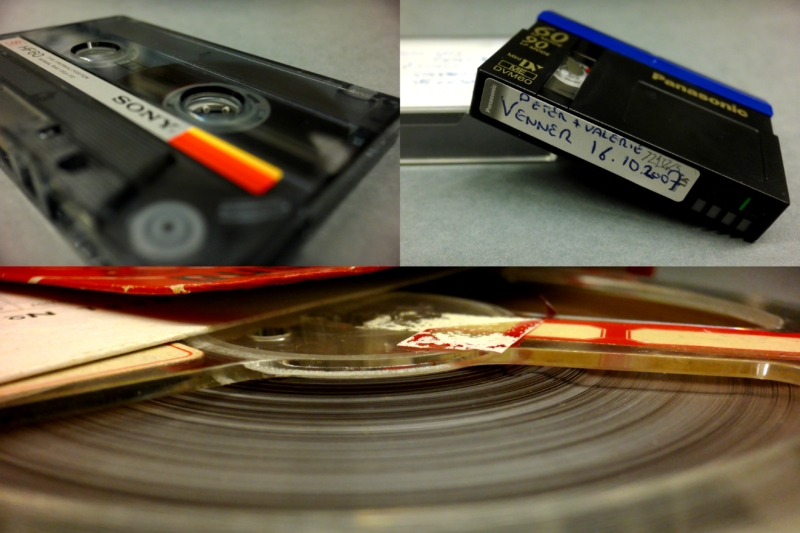
Compact cassette Top-right: MiniDV tape Bottom: Reel-to-Reel tape
The Cultural Importance of Oral History
Now, this may all sound like a lot of effort for a few sound clips, but the importance of our oral history collections cannot be overstated. For those of you not familiar with the term, oral history simply refers to history that is preserved as a sound recording, often framed in the context of an interview, where the interviewee shares notable experiences from across their life. The spoken word can preserve much more than its written equivalent; intonation can reveal emotion on the speaker’s behalf, as well as nuances in their speaking manner, indicating dialects and accents. Some aspects of speaking, such as the use of sarcasm, cannot even be accurately translated into written word, which can lead to gross misinterpretation of the speaker’s original message. There are other benefits too; many members of the public prefer listening to reading, finding it easier to absorb information through auditory stimulation, and as well as this, oral history collections often provide primary sources of information about the spoken topic, usually related directly from the experiences of the individual speaking.
A fantastic example of the often unique material provided by our oral history collections can be found in the Exmoor Oral History Archive. The collection contains several eyewitness accounts of the 1952 Lynmouth flood, an event which is often considered one of the most significant disasters in Exmoor’s history. These accounts provide a much greater level of insight into the effect the flood had on local residents than (in my opinion) any newspaper clipping can convey. The very fact that the individual’s voice can be heard preserves an aspect of their experiences that would otherwise be lost, and once the recordings are made available online, I strongly encourage anyone remotely interested in the history of Exmoor, and even the larger South West, to take the time to listen through some of these recordings, as they provide an unmatched insight into rural life on Exmoor during the 20th Century. As we move further into the 21st Century, we can expect to see oral history recordings more often accompanied by films of the interviewee speaking, which preserves a further aspect of their experiences, and allows us to clearly see their expressions and gestures, providing yet further insight into the speaker’s experiences. This has already begun to seep into oral history collections, with a notable example being the Appledore Maritime Heritage project, which features video recordings of nineteen interviews conducted in 2008 with residents of Appledore, a historic fishing village in North Devon. I believe this is the shape of things to come for oral history projects, and that we will see shift towards multimedia focused collections, possibly even featuring video recordings of mentioned subjects and locations, completely preserving the experiences of the speaker.
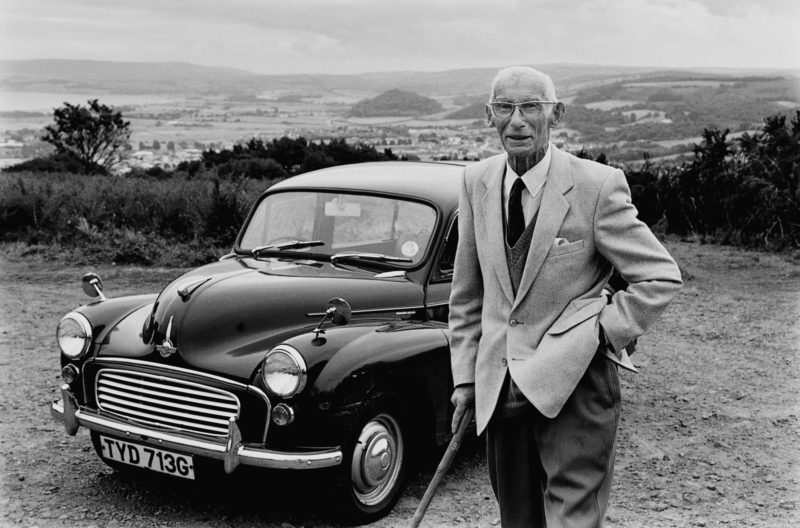
Rattenbury