
Student Fran Morris joined the team over the summer to gain some valuable work experience. She is studying paper conservation at Northumbria University and has successfully completed the first year of her studies. Fran worked with Conservator Lucy Cokes to learn more about archival conservation.
My interest in conservation first began after working in a picture-framing gallery in Bristol. I found myself enjoying persevering the older more worn-down frames and art works. I shortly found myself enquiring at local conservators in different professions and became drawn towards the art-on-paper conservation discipline. I then applied for the MA in Conservation of Fine Art at Northumbria University.
I was fortunate enough to gain a placement here at The South West Heritage Trust in Taunton, and was given the opportunity to explore not only paper conservation, but many other disciplines which relate to conservation practise and management.
Royal Ordnance Factory Architectural Plans
The main aim for conservation projects is to increase an object’s longevity as well as making them more accessible, stabilising them for handling by archivists and the general public.
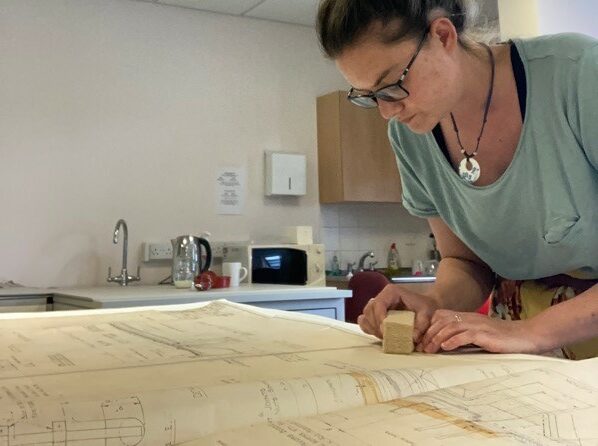
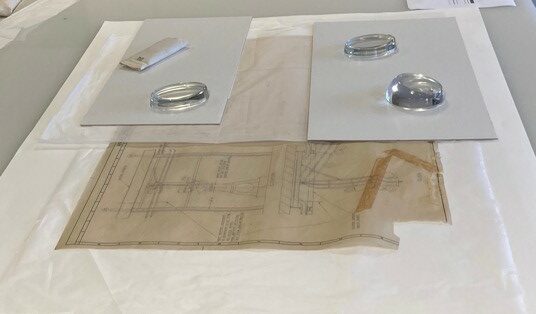
Alongside volunteers, the first project I worked on was a series of architects’ drawings created in and around 1957, which had been completed on various different materials – some on paper, others on tracing paper. The majority were on a type of wax paper, blue in colour. We initially treated them with a surface clean – using a soft brush and then a smoke sponge to remove surface dirt and dust – avoiding any of the carbon-based media, as this could be lost with over-zealous cleaning. Some of these documents required local humidification for the more ingrained creases, and then gently pressed to encourage them to relax back into their original state until flat. They were then gently rolled using a supported method and labelled according to their project name, allowing for more organised and careful storage.
Bath and Wells Probate Accounts
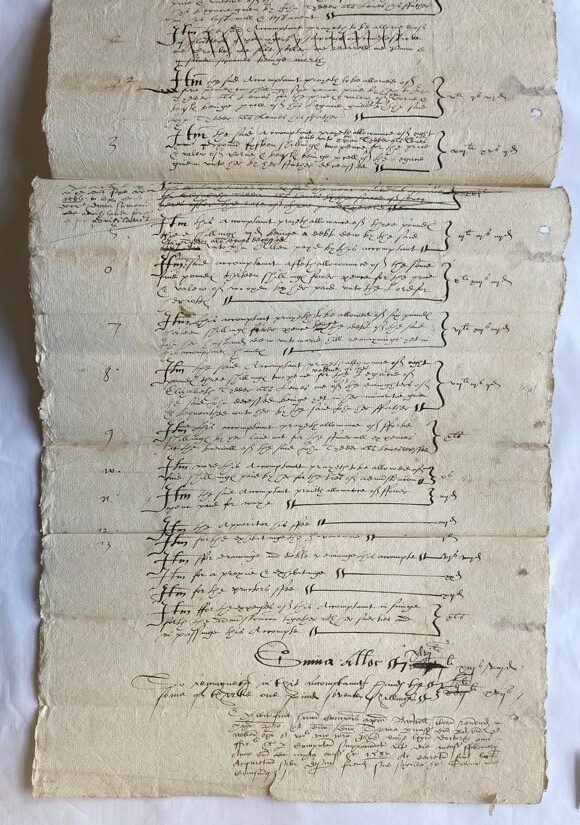
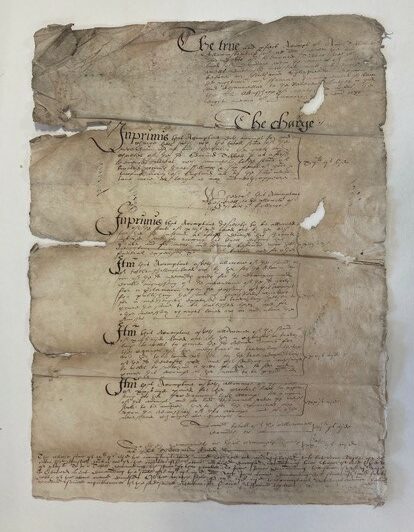
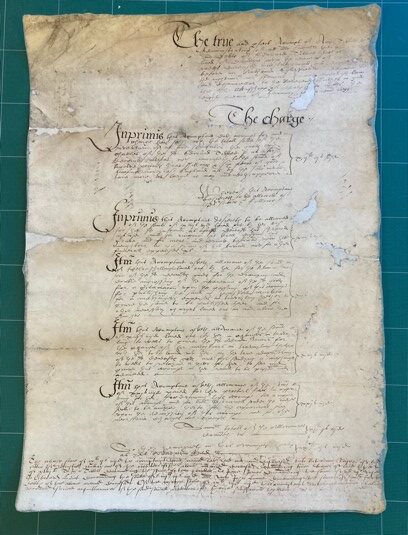
My main project consisted of repairing the Bath and Wells Probate Accounts, with documents dating from 1550. There are hundreds of these documents, so quick and precise work was vital to achieving a satisfying result. These documents had watermarks (often two to a page), iron gall ink, and were produced on laid European paper.
These documents had been found in awful conditions underground for such a long time, most had water damage, pest damage and signs of mould damage – I should note the mould at this point was inactive – it had, however, left lots of staining behind. The accounts came in boxes in varying conditions. Some only required surface cleaning and correct housing. However, most were in need of further treatment due to damage.
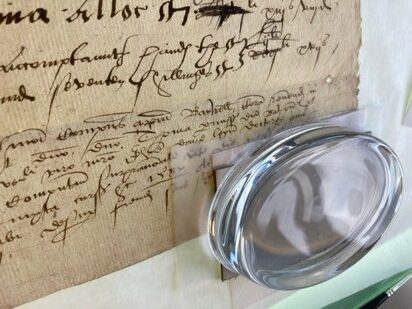
Documents that had lots of smaller tears required local tear repair, thus allowing for better handling and prevention of further damage. In areas where damage had occurred where text was also present, it was vital to maintain the readability whilst also repairing the affected areas. This was achieved by using a thin but strong repair paper. This allows the reader to both handle and read the document through the repair paper.
As the documents had originally been folded up into thirds, tearing was more prominent around these creases. The use of gentle handling to unfold these documents for treatment was very important. Many of these pieces had fragments of paper coming away from the edges – these were carefully stored in an archival folder with the correct document.
Many of the documents had large areas of loss and required immediate attention and treatment. The documents were lined and then infilled, allowing for much better stability and accessibility for the reader.
Adhered letter
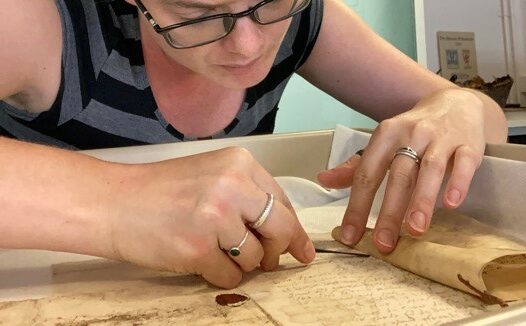
One document in particular required separation. It was established that one page was parchment and the other paper, and that somehow the two had become stuck together. This was tricky as it was unknown what was sticking these two pieces together, though it was likely as a result of previous water damage. The treatment here was controlled humification; parchment is very temperamental in conditions that are too humid and can curl and discolour. Constant observation was required during this process. After humidification, I spent a good part of the day very gently separating these two materials, which would then allow for the document to be seen and read. This took extreme caution. The aim here were to maintain the information on the paper – if this was not possible then we would need to find an alternative means of separation. Thankfully this was not needed, the two became unstuck with the use of humidification and a micro spatula. These documents will be kept together as they are, however, Bondina is now placed in between them to prevent possible sticking from occurring in the future.
Bookbinding
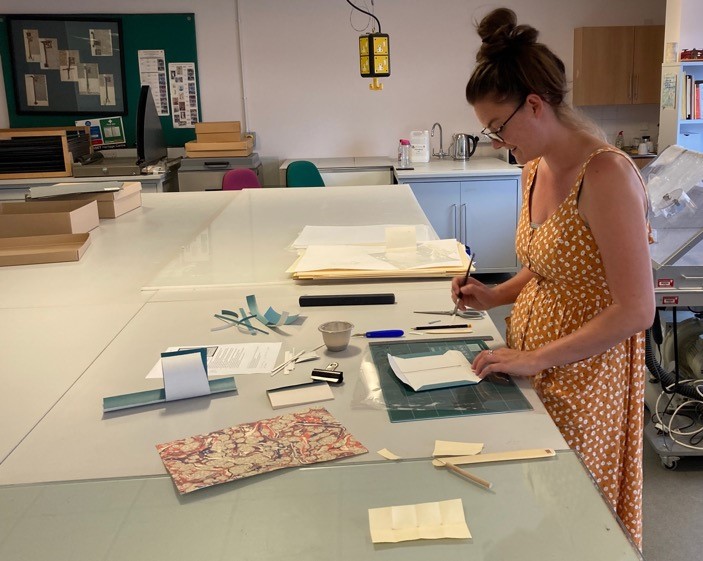
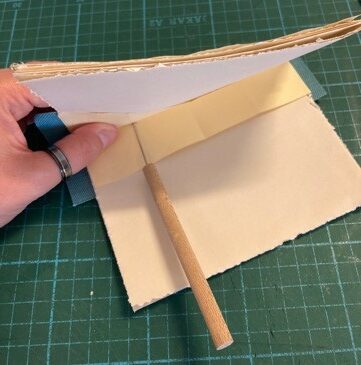
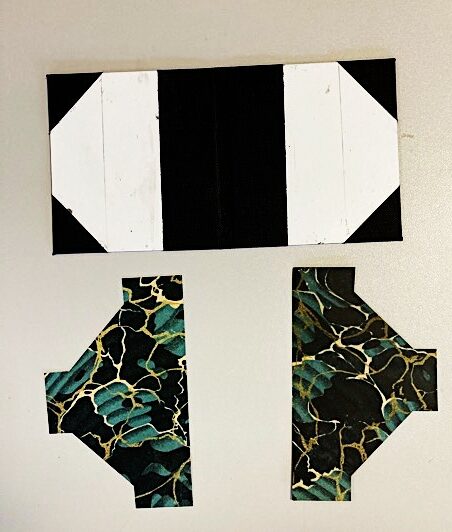
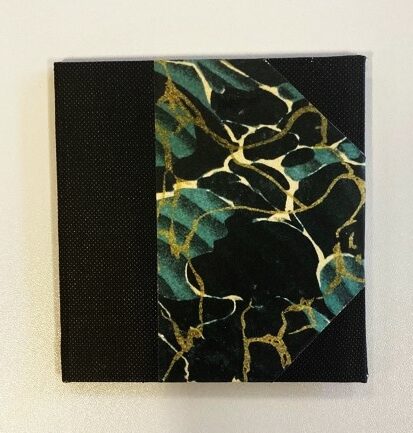
A really interesting part of this work placement was having the opportunity to have a book binding workshop. Conservator Lucy Cokes took lead in teaching the ways in which a book can be made, staring with the basics and then having the opportunity to make a more complex book after.
The way in which you can design and make these booklets allows you to make them as thick or thin as you wish, and they make fantastic note pads or drawing pads. This is something I would encourage others to try and hope to make more myself in the future.

Outreach
Getting the word out about conservation practises and how and why conservators do the things they do is an important part of our jobs. At the Trust they fully support this notion and encourage those from a young age to get involved. This has been achieved via liaising with a local school who in turn encouraged their students attended careers days organised by the Trust.
I assisted in providing year 9 students with a taster in conservation. This was a very positive experience and allowed the students to freely ask questions on the subject whilst also giving them on hands experience in a technique used in conservation– they surface cleaned some documents and learned about the materials we use.
Thanks and Acknowledgments
Overall this work placement has been such a great experience for me. I have learnt a great many things whilst working on the various projects here, under the guidance of Lucy, who has been a great mentor in teaching me a range of techniques; including bookbinding, treatment of architectural drawings and the various materials, localised humidification techniques for larger objects, making of consolidation solutions and use on paper and leather books, general practices within the heritage trust which have all been invaluable to my learning in paper conservation.
One technique taught in particular was a lining technique, applied on very degraded documents. Applying this lining treatment, these objects will now be more stable and accessible to archivists and others, making this something that I personally find very fulfilling to be able to achieve. This was extremely useful and at the same time challenging. It is something I hope to perfect over time.
It is always useful to know of different ways one treatment can be achieved, even coming in with previous knowledge it is invaluable to know the various ways in which even a starch paste can be made, stored, sieved and diluted. I would like to say a huge thank you to Lucy who has helped me and spent so much of her time teaching me so much whilst on placement here as well as the South West Heritage Trust for allowing me to work on their various collections and gain an in-depth insight from them.