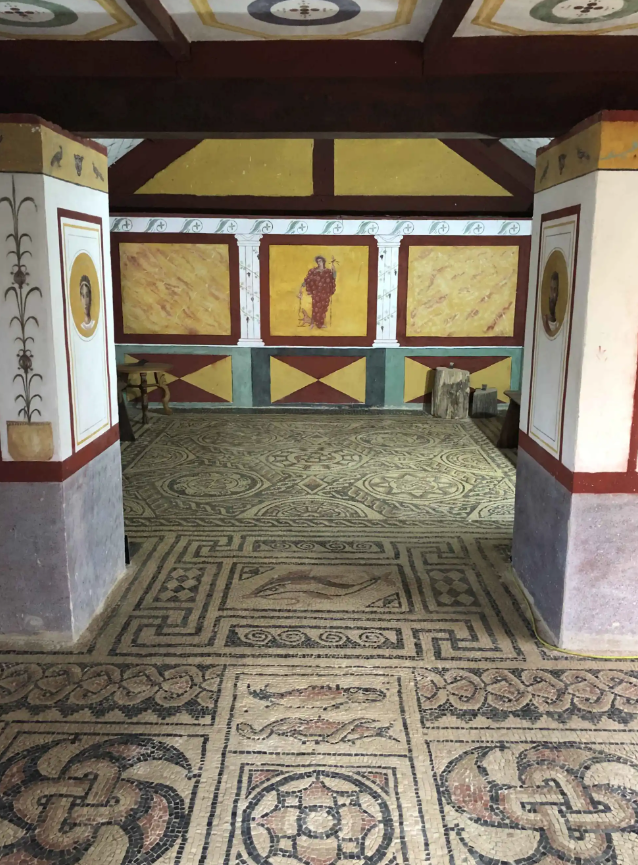
Avalon Archaeology is pleased to announce that the mosaic floor inside the Roman Dining Room reconstruction is now complete. The mosaic has been painstakingly laid by a team of dedicated volunteers and has taken five years to complete.
The Volunteers
The volunteers spent two years hand-making the 140,000 stone and tile cubes (tesserae) using the same tools as the Romans did. Over the following three years they painstakingly recreated a series of mosaic designs copying ones from Roman villas that had been excavated in Somerset.
It is believed to be the only recreation of a Roman mosaic in the UK made entirely by untrained volunteers, using the same materials and techniques as the Romans did.
Almost 25 volunteers have been involved in the mosaic over the years, working one day a week, with between two and five people involved each day.
‘I had always wanted to create a mosaic, so was delighted to be involved but I didn’t think that I would still be working on it four years later’. Martin Day, volunteer.
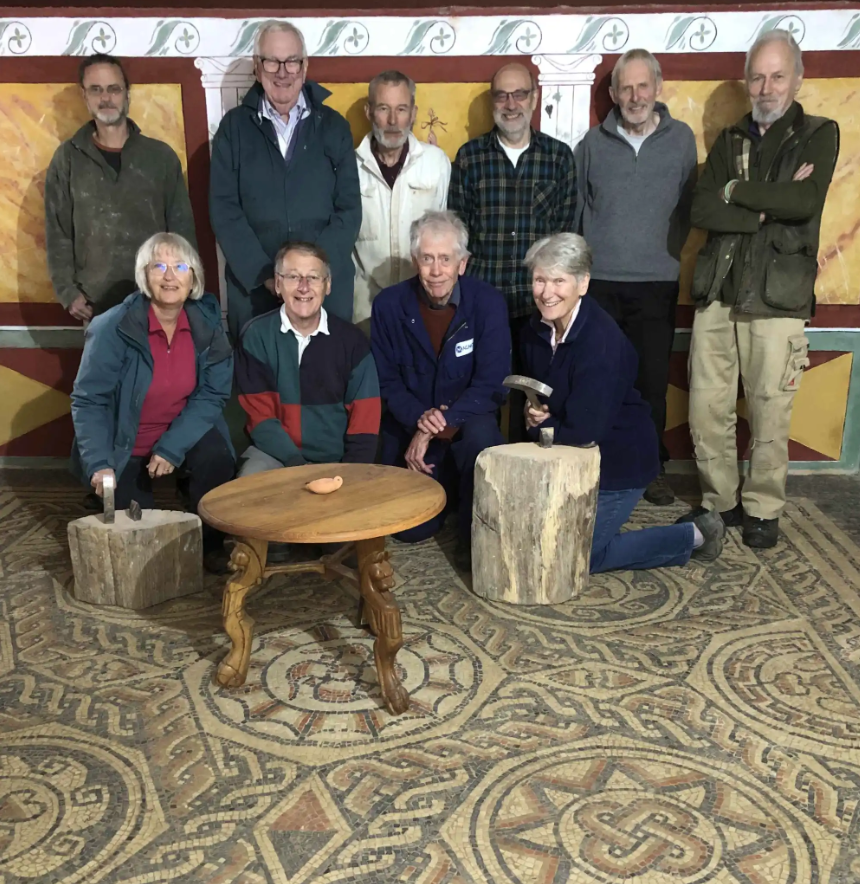
Omnis laus tessellarii, as the Romans may have said (‘all praise the floor mosaicists’).
The Process
The stone is the same local material that the Romans used, with white, blue and grey lias, yellow Doulting stone and red made from tiles. The individual cubes were created using a hammer and ‘hardie’ (similar to a chisel set upright in a block of wood) and were laid in a bed of lime mortar.


The Design Inspiration
Different parts of the mosaic design have been inspired by Roman villa mosaics across the county and the final result is a ‘best of Roman Somerset’ mixture. Inspiration has come from locations such as Whatley Roman villa, Hurcot villa, Newton St Loe villa, Lopen villa among others.
The Elephant

The elephant mosaic from Whatley Roman villa has been recreated, albeit at a smaller scale than the original. The villa, near Nunney in Somerset was discovered in 1837 and excavated 1848 and 1958. A reinterpretation based on a photograph and lithograph was used as a guide for the elephant. Roman mosaic elephants on the continent usually appear more realistic and have the right sized ears whereas British mosaicists seem to have been more conservative in their ear depictions, perhaps because they had never seen an elephant and so couldn’t comprehend an animal having such huge ears in relation to its head.
Roman trompe l’oeil
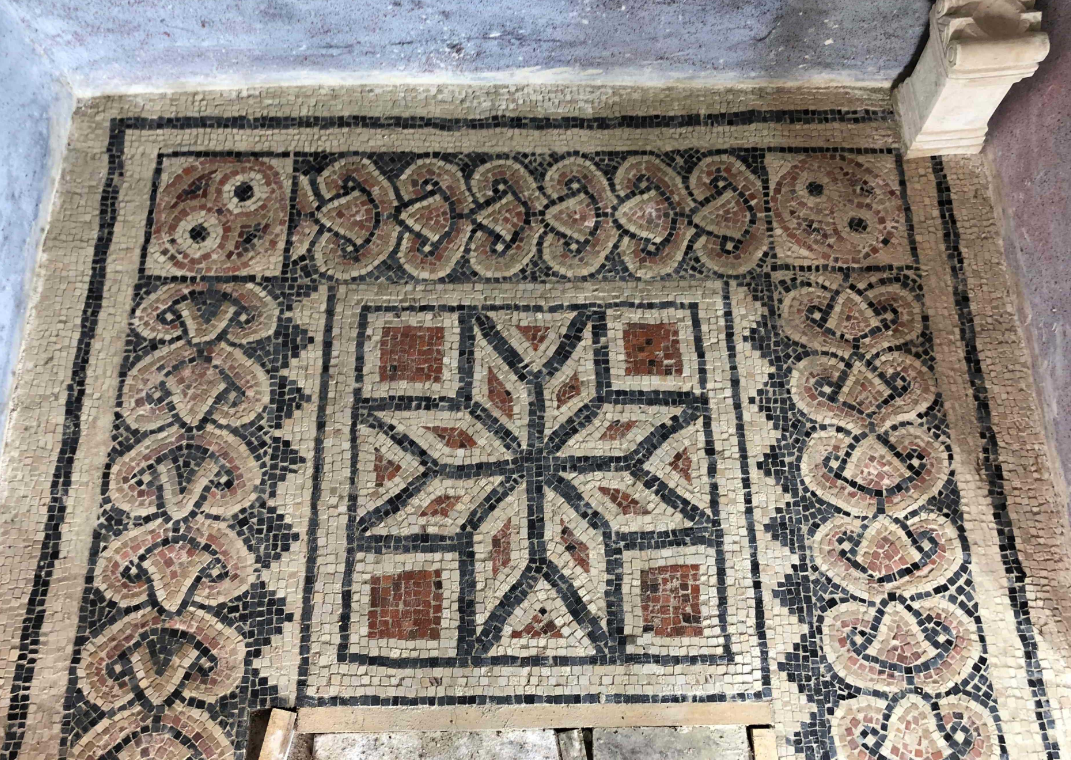
The Romans often included eye-deceiving images in both frescoes and mosaics. One example in the mosaic floor is based on one from the Newton St Loe villa, Somerset. Some viewers see a flower, or star, or four converging cubes, or, four converging Toblerone shapes.
The Guilloche Border
The pattern of interlocking squares is based on the Hurcot villa mosaic, and the colourful guilloche border was inspired by a design from the cold plunge pool at Lufton villa.
The Dolphin


The dolphin design was inspired by Lopen villa in the south of Somerset, which was discovered by chance in 2001.
The dolphin design was initially sketched out in the wet lime mortar, before its gradual formation using tesserae, after which a thinner mortar wash was applied to fill in the cracks and then washed off. The viewer can decide whether the surrounding waves are black or white.
Viewing the Completed Mosaic
‘The finished result is a great testament to the dedication of the volunteers, who have produced a great work of art despite having no prior experience.’ Project lead, archaeologist Richard Brunning
The volunteer group and the wider project have benefited from a grant from the National Lottery Heritage Fund, which was instrumental in allowing the Avalon Archaeology site to open to the public in 2023.
-
You can view the mosaic at Avalon Archaeology, open every Sunday. For more information about your visit see the Admissions page.
-
Find out more about the Roman Dining Room reconstruction here.
-
You might like to visit the Roman reconstruction during the Winter Warmer Day on Sunday 16 February 2025, where you can also see the Roman hypocaust in action.
-
Watch the film series on Avalon Archaeology’s YouTube channel, and the volunteer team in action.